
Polish name: Pędraki, chrabąszcze
Latin name: Melolontha spp., Phylopertha spp., Amphimalus spp.
English name: White grubs (larvae), May beetles (adults)
EPPO code: MELOME, AMHISO, PHPHHO
Class: Insects (Insecta)
Order: Beetles (Coleoptera)
Family: Scarab beetles (Scarabaeidae)
Key species:
- May beetle – Melolontha melolontha L., EPPO code: MELOME
- Summer chafer – Amphimallus solstitiale L., EPPO code: AMHISO
- Garden chafer – Phyllopertha horticola L., EPPO code: PHPHHO
Gallery

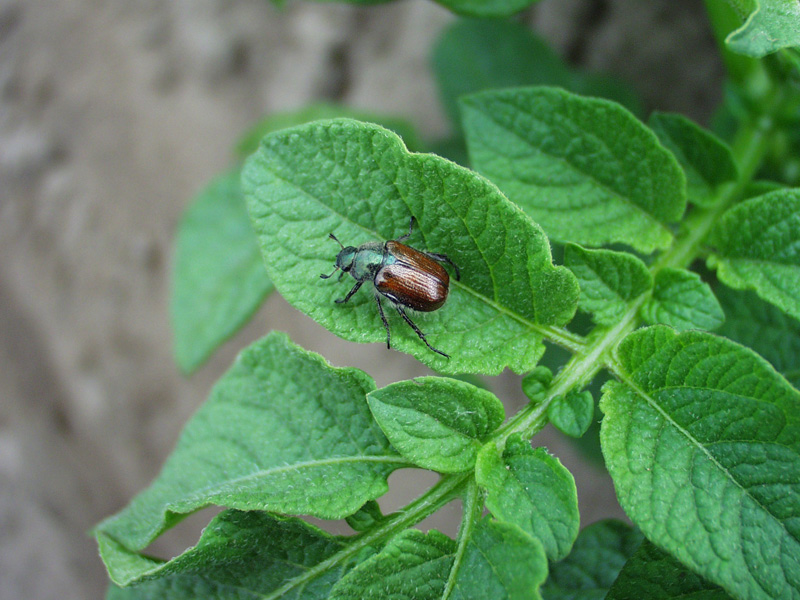
Scarabaeidae beetle (species: garden chafer)
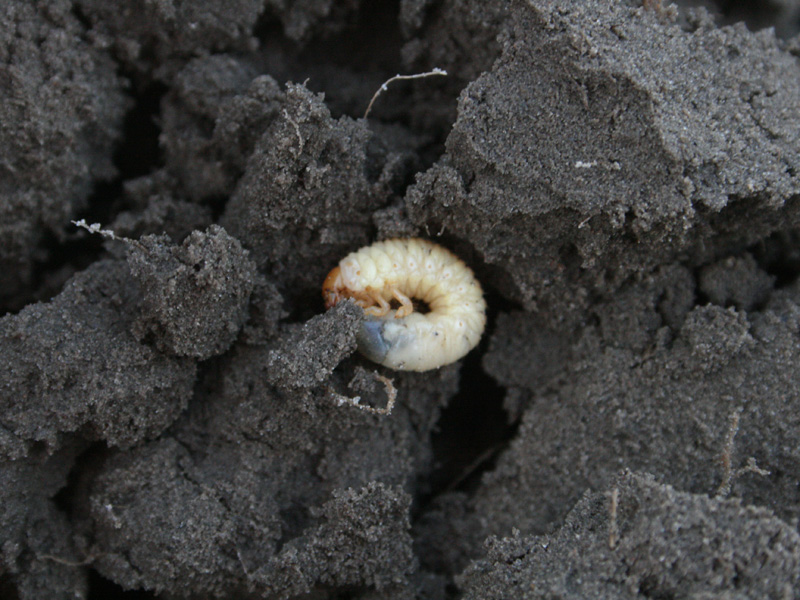
Larvae in soil (white grubs)
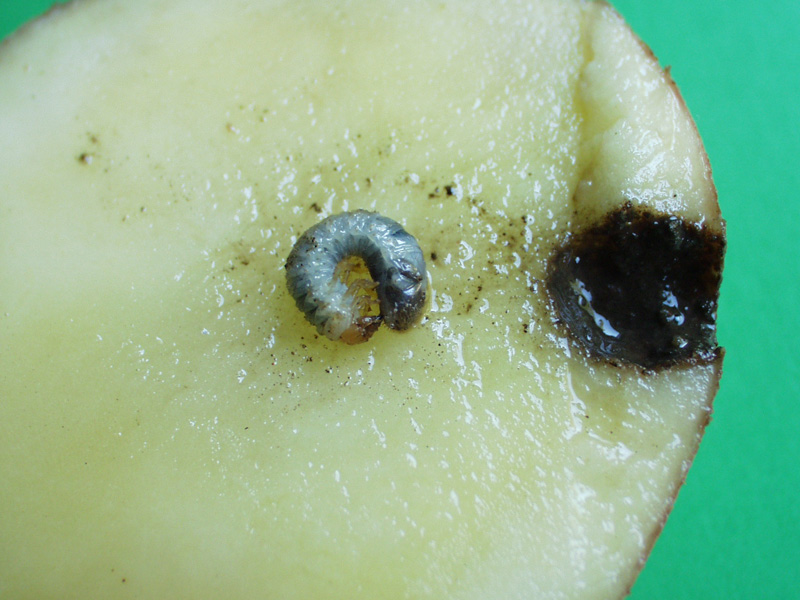
Larvae in soil (white grubs)
White grubs are the larval stage of scarab beetles. They live in the soil, feeding on roots of various plants, causing weakening or death of the plants. Adult beetles (may beetles) feed on foliage and are active mainly during late spring and early summer.
White grubs are the larval stage of scarab beetles. They live in the soil, feeding on roots of various plants, causing weakening or death of the plants. Adult beetles (may beetles) feed on foliage and are active mainly during late spring and early summer.
Insects belonging to the scarab beetle family are common pests of crops and garden plants. The listed species differ in size and distribution within the country, occurring in specific regions and soil-environmental conditions. Their presence in fields is often associated with nearby tree stands. The larvae – known as white grubs – cause the most damage, although adult beetles can also directly harm leaves and flowers during spring flights. In potatoes, the greatest damage is caused by the larvae of the aforementioned species, as they gnaw on roots and damage tubers in the soil.
Bionomics
- Eggs – oval, milky-white, laid in soil holes in clusters of 20-30.
- Larvae (harmful stage) – 10-28 mm long (smallest stage L1), cream-yellow with a brown head; larvae grow in size with each stage (largest L3 up to 65 mm), C-shaped (U-form) with 3 pairs of thoracic legs and strong mandibles (photos 2A, 2B). Larvae of Amphimallus and Phyllopertha are smaller than those of the May beetle. They pass through 3 larval stages differing in body length and head capsule width. The posterior abdomen is thickened and fatty, ending with 2 rows of small spines. Development cycle: May beetle 4-5 years, Amphimallus 2-3 years, Phyllopertha – 1 year.
- Pupa – free type, 20 mm long, light brown.
- Beetles – body length up to 25-30 mm for the May beetle, 14-18 mm for Amphimallus, 9-12 mm for Phyllopertha (photo 1). Sexual dimorphism is visible in the number of fan-shaped plates on the antennae (male 7, female 6). Elytra are brown, pronotum black, abdomen tip (pygidium) visible. Adults are flying insects, active in evenings and during spring mating flights, feeding on leaves and causing defoliation. Elytra of Amphimallus are yellow-brown (hairy underneath), Phyllopertha is brown, pronotum metallic blue-green (hairy body). Flights: May beetle in May, Amphimallus and Phyllopertha in June.
Life cycle
Overwintering stages are adult beetles in winter shelters and larvae of different stages, in soil at 30-100 cm depth. Some young beetles and grubs die during winter. Mortality depends on winter depth and activity of pathogenic fungi and nematodes. First adult beetles emerge in early May (during the flowering period of lilac, broom, and dandelion) when soil reaches +11°C. During mass emergence, beetles seek trees for mating, feeding supplementarily, then lay eggs in the soil. The first eggs (80-100 in total) are laid in May, in clusters of 15-20 eggs per burrow at 10-20 cm depth. Egg development lasts about 30 days. Larvae hatch by the end of June and develop for 4-5 years depending on the species, molting annually (the most voracious L3 stage causes the greatest yield losses). Mature L3 larvae feed until June, then pupate in deeper soil layers. In September–October, young beetles emerge and remain in soil until next spring.
Occurrence and damage
White grubs (larval stage) are polyphagous (feed on all cultivated plants, vegetables, and ornamentals). During spring flights, adults feed on leaves of deciduous trees (chestnut, poplar, willow, beech, oak, apple), causing defoliation (new leaves emerge only in June–July from dormant buds).
The species is widespread throughout the country and locally can cause severe damage. Highest populations are noted in north-western, central, and southern regions, especially where fields are near deciduous tree stands. High larval densities (e.g., in post-harvest fields – photo 3) can lead to complete destruction of tubers.
White grubs are among the most serious pests of potatoes. Young larvae (L1) feed on plant debris, while older larvae (L2-L3) damage all underground plant parts (tubers, stolons, roots – photos 4A, 4B, 5). Direct yield losses can reach 40-50% in heavily infested fields.
Economic threshold
A signal for chemical protection is the threshold of 5 large larvae per 1 m² of field area.
Monitoring can be done via field observation and soil analysis (32 holes diagonally across the field) before planting tubers. Soil bait traps (10-20 per hectare) can also be installed diagonally across the field.
Control methods
Control of overwintering white grubs (4-year cycle) is performed after exceeding the economic threshold by treating tubers with insecticidal seed dressings. Optimal timing is during potato planting (larvae searching for food after winter), i.e., April–May. Grubs are moderately sensitive to applied insecticides.
Protection is difficult due to the limited number of registered products. The only method currently is treating tubers at planting with insecticidal-fungicidal dressing Prestige Forte 370 FS, which acts both contact and systemically, eliminating soil-feeding grubs on mother tubers for up to 4 weeks after planting. Later, it also protects against Colorado potato beetle and aphids as the systemic insecticide circulates in young plants. High infestations may reduce effectiveness since new grubs may damage tubers until harvest. The treatment effect ends after 10–12 weeks, and larvae not previously exposed may damage young tubers, often causing damage shortly before extended mechanical harvest. No other soil insecticides (organophosphates) are currently permitted.
Agrotechnical methods are not fully effective but can reduce larval numbers (proper crop rotation, catch crops like mustard and oilseed rape, non-host plants, timely agrotechnical measures, deep plowing, soil loosening). Winter plowing can expose larvae to birds or low temperatures. Overwintering larvae are treated in spring after threshold exceedance via tuber dressing, creating a protective insecticidal layer around mother tubers. Optimal timing is April–May. Larvae are sensitive to applied agents.
Supplementary control includes biological agents (entomopathogenic nematodes) during the growing season. Application targets soil-active larval stages and depends on careful field monitoring. Biological agents require high soil moisture or irrigation. Spraying is performed on cloudy days using field sprayers. This method is costly and mainly suitable for small areas.
Compiled by: Dr. Tomasz Erlichowski