
Polish name: Rolnica czopówka
Latin name: Agrotis exclamationis
English name: Heart and dart moth, larvae – cutworms
Kod EPPO: AGROEX
Gromada: Owady (Insecta)
Rząd: Motyle (Lepidoptera)
Rodzina: sówkowate (Noctuidae)
Podrodzina: rolnice (Noctuinae)
Gallery

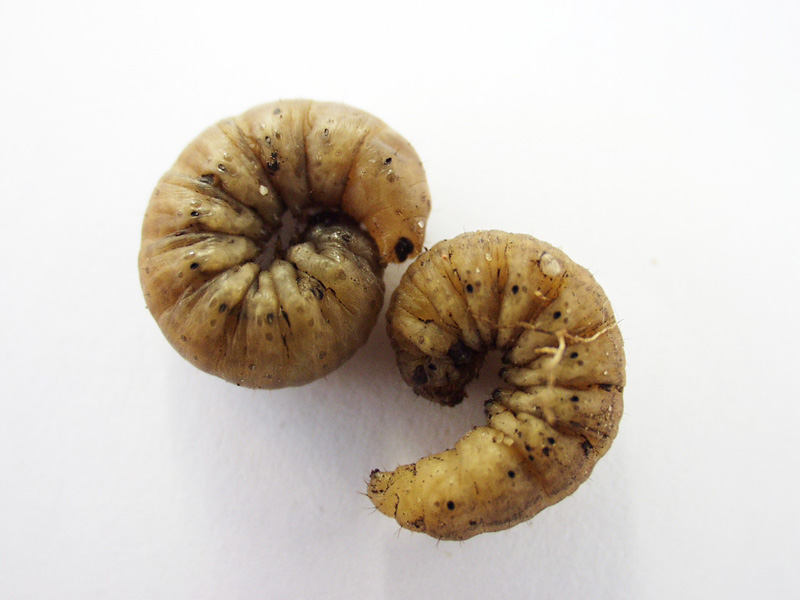
Cutworm larva
(photo: S. Wróbel)
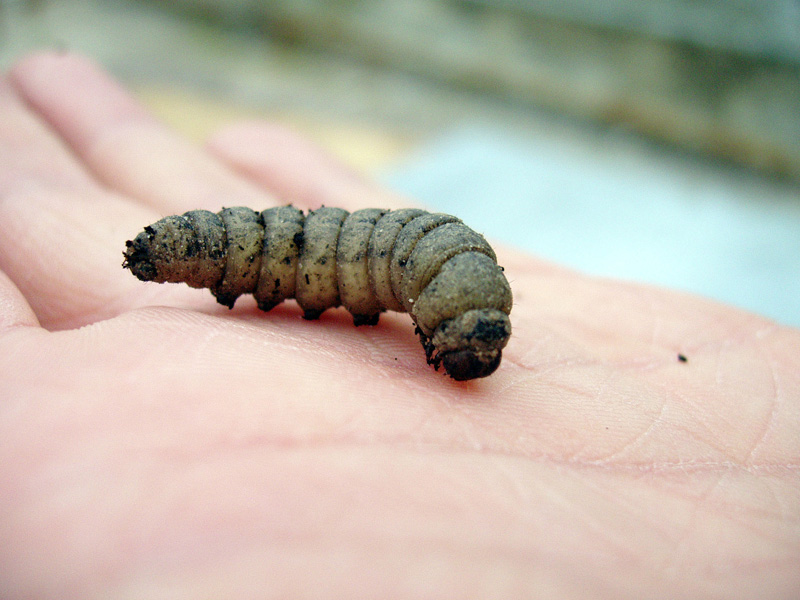
Cutworm larva
(photo: S. Wróbel)
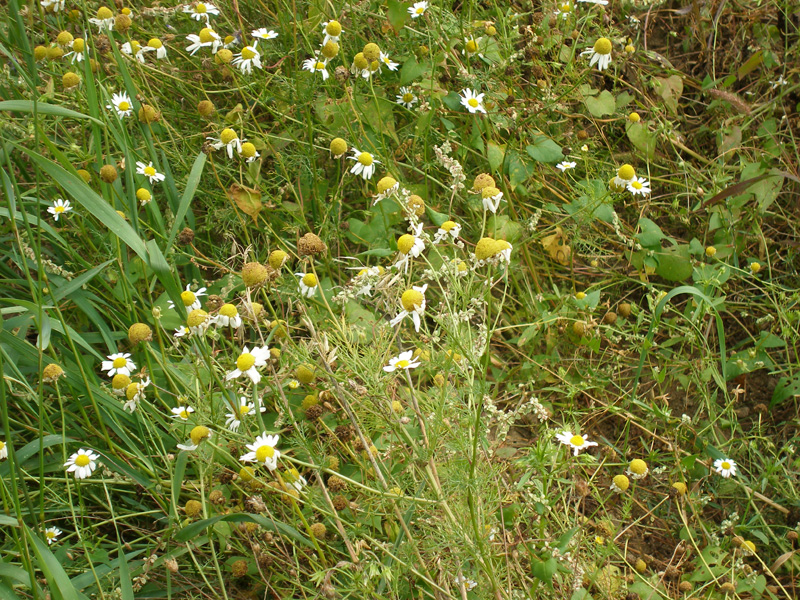
Kwitnące chwasty w ziemniaku stymulują składanie jaj przez motyle
(fot. T. Erlichowski)
Characteristics and description of the pest
Cutworms are polyphagous (associated with cultivated plants and weeds) with a large number of species. In the case of cultivated plants, a few species pose a threat. Recently, due to changing climatic factors – more dry and warm periods – this pest has increased its presence, reproduction, and harmfulness. In Poland, besides potatoes, they are observed feeding on winter cereals, grasses, tobacco, maize, tomatoes, sugar and fodder beet, as well as on numerous vegetables. Their stages also feed on wild-growing weeds – Polygonum sp., Elymus sp., Plantago sp.
Bionomics
- Eggs – small, oval, laid in quantities of 800-1200, singly or in small clusters, attached to plants, stems, or on the soil surface.
- Larva (harmful stage) – 35-40 mm long, brown or grayish-brown in color, hairless, with 2 spots on each segment. Lives in the soil (phot. 1A, 1B), emerging at night to feed on cultivated plants (polyphagous species). Older larvae remain in the soil until pupation, damaging tubers (roots, stolons). When disturbed, they curl into a spiral. Overwinters in the soil.
- Pupa – closed type (cocoon), brown in color.
- Adult insect – moths thick-bodied, hairy (phot. 2), wingspan 32-45 mm. Active at night (moth). At rest, wings folded roof-like. Forewings yellow-gray with characteristic wedge-shaped and kidney-shaped markings, darker in females than in males. The second pair of wings short and white. Emergence occurs in warm spring (May-June) and in summer (August), with 2 generations per year. Sometimes moths overwinter.
Life cycle
The heart and dart moth overwinters as larvae in the soil. After spring pupation, first-generation moths emerge in May – June, lay eggs, and the first generation of larvae appears on plants in June – July. Females lay eggs on weeds, plants, or on the soil. Larvae hatch after about 4 weeks. Initially, young larvae grow and feed on plants; older ones bury into the soil (in holes) or under clods and emerge at night to feed. Pupation occurs in the soil. The second generation of moths appears in August.
In Poland, the species usually develops 2 generations per growing season. The life cycle of the heart and dart moth is very similar to other polyphagous cutworm species (also damaging potatoes) – such as the turnip moth (A. segetum) and the yellow-striped armyworm (A. ipsilon).
Occurrence and harmfulness
The species occurs widely and abundantly in Europe (due to rich crop rotations, 80 percent cereals), and in Poland it is abundant mainly in warm, dry, and rainless years. It occurs in outbreaks. The highest abundance is noted in summer in western, central, and southern regions.
Adult insects – moths – do not damage plants, feeding on pollen from flowering plants and weeds. In favorable periods, they fly long distances, seeking sites for laying eggs and reproduction (phot. 3). Larvae are pests mainly of field crops and vegetables, appearing more abundantly in warm and dry years. They are important potato pests; under high infestations, young larvae feed on leaves and cut young stems before tuber formation (phot. 4), causing them to fall and wilt. Older larvae (in the soil) feed on tubers, hollowing them out (phot. 5, 6), reducing their quality. Early in the season, larvae also feed in the evening on plants. Potato losses can reach up to 50% of yield during migratory flights and sudden outbreaks.
Economic threshold
To monitor cutworm larvae after winter, field observations before planting potatoes are sufficient. Soil excavations are performed to locate overwintering larvae (similarly to wireworms or white grubs).
In spring, in assessing the soil site, the threat is already 4-5 larvae/m² averaged over the field. In summer, monitoring adult flights, sticky traps are used (phot. 7) with species-specific pheromones to catch males. Counting moth catches over 2-3 days provides information on population dynamics and when to perform protective treatments.
Control methods
The primary methods of protection are chemical treatments (insecticides), especially foliar sprays containing chlorpyrifos. Currently, according to the latest regulations, this active substance can only be applied foliarly during the season. Chlorpyrifos (Nurelle 550 EC) has strong contact, stomach, and fumigant activity, performing well in dense stands in summer and at higher temperatures. In controlling larvae from the summer generation, understanding the pest’s biology is important, as smaller larvae, L2-L3, emerge from the soil at night, making them easier to control with late-evening and night treatments. For larger larvae, L4, which stay hidden in ridges near tubers, achieving high efficacy is very difficult.
Agronomic method (crop rotation, shallow tillage, weed removal, optimal nitrogen fertilization). From the perspective of cutworm protection, it is very important to maintain fields and surrounding margins free of flowering weeds, which stimulate females (during flight periods) to lay eggs. In June-July, larvae are also controlled during routine potato beetle treatments (foliar sprays).
Compiled by: Dr. Tomasz Erlichowski