
Nazwa polska: Skoczek ziemniaczak
Nazwa łacińska: Empoasca decipiens
Nazwa angielska: Green potato leafhoper
EPPO Code: EMPODE
Class: Insects (Insecta)
Order: Homoptera (Homoptera)
Family: Leafhoppers (Cicadellidae)
Gallery

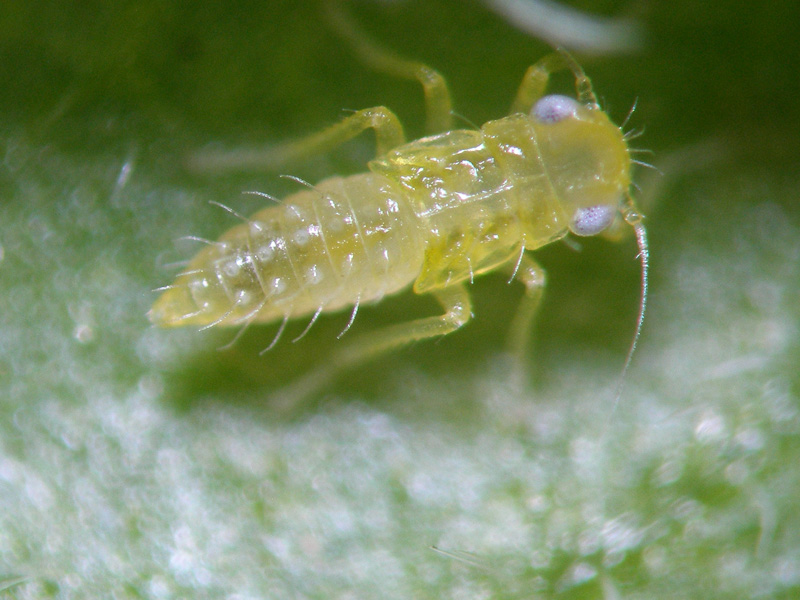
Potato leafhopper nymph on a plant
(photo: T. Erlichowski)
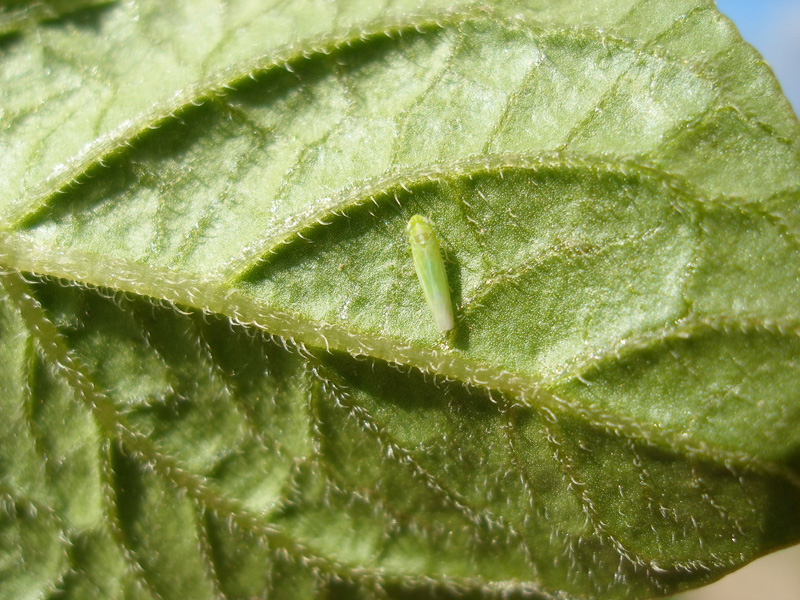
Adult potato leafhopper on a potato leaf
(photo: T. Erlichowski)
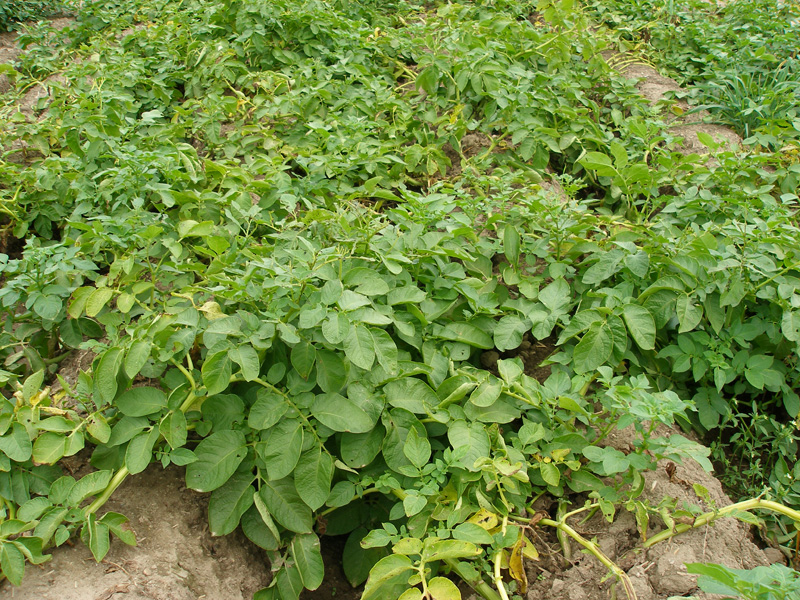
Plantation in August after pest occurrence
(photo: T. Erlichowski)
Characteristics and pest description
Leafhoppers are polyphagous insects (associated with cultivated plants and weeds). A very large number of species occur. In Poland, apart from potato, their feeding has been recorded on broad bean, marrow, bean, cucumber, alfalfa, sugar beet and fodder beet, as well as on numerous ornamental plants. In greenhouses they damage cucumbers, tomatoes, eggplants and peppers. Their developmental stages also feed on wild-growing plants, including about 30 weed species. As true bugs, they possess piercing-sucking mouthparts, suck plant sap and cause both direct and indirect damage (they transmit viruses and mycoplasmas).
Bionomics
- Eggs – small, oval, white, laid singly and attached to potato leaves as well as other cultivated plants and weeds. Egg length is about 0.2 mm.
- Larva (nymph), the damaging stage – 2–2.5 mm long (youngest 0.5–1 mm), light green to green in colour; body size increases with each larval stage. Wingless up to the 4th larval stage; wings appear in the 5th larval stage. Head, legs and thorax are light green, the body transparent, eyes white. Lives loosely in colonies, mainly moving on the underside of leaves; when disturbed it runs (photo 1).
- Immature individual (nymph), although wingless, resembles the adult insect.
- Adult insect – body length reaches 3–4 mm. Particularly active during warm spring periods while searching for new host plants and in summer (high temperatures). Thermophilous species. The summer generation is very numerous and active, causing direct damage. Forewings are held roof-like (photo 2). A flying insect that jumps when disturbed (enabled by the structure of its jumping hind legs).
Life cycle
The potato leafhopper reproduces sexually. The female lays eggs singly, mainly on the underside of leaves near veins and vascular bundles. Larvae hatch after 1–4 weeks. Their development lasts approximately 10–37 days depending on temperature and host plant. Metamorphosis is incomplete; wings are absent until the fourth larval stage, and the winged fifth stage becomes the adult. Temperatures of 24–28 °C and lack of rainfall are most favourable for development. These insects are most often found on the underside of leaves. They can jump and fly short distances, which makes them highly mobile.
In field cultivation the potato leafhopper usually develops 2–3 generations per year, and up to 4–5 generations in greenhouses and under covers.
Occurrence and harmfulness
The species is common and abundant in Europe; in Poland it is particularly numerous in warm, dry and rainless years. The highest populations are recorded in summer, especially in central and southern regions. This leafhopper is considered a moderate potato pest, unlike many other leafhoppers such as the polyphagous American species Empoasca fabae (virus vector) or Hyalesthes obsoletus (stolbur phytoplasma vector). The species E. decipiens (potato leafhopper) is not considered a vector of viruses or other plant diseases in Poland. Adults and larvae (nymphs L1–L4) damage all green parts of potato plants. Initially, feeding consists of sucking sap from leaf blades, main leaf veins and stems. White spots appear at feeding sites as a result of tissue puncturing. During heavy infestation plants turn yellow (photo 3), wilt and leaves droop. Yield losses may reach up to 10%. Symptoms are intensified under drought conditions or nutrient deficiency.
Economic threshold
Not established in Poland.
Control methods
Under Polish conditions, leafhoppers are usually not controlled directly. Agrotechnical methods (crop rotation, shallow cultivation, weed removal, optimal nitrogen fertilisation) provide only supportive limitation.
Basic protection relies on chemical treatments – insecticides used during routine Colorado potato beetle control or biological products (Spinor 240 SC) applied during the growing season. Treatments are especially recommended during larval hatching of generations L1 and L4; therefore, careful field monitoring is necessary. The simplest control method is tuber dressing during planting with an insecticidal-fungicidal seed treatment Prestige Forte 370 FS, which works from emergence, has systemic action and circulates within the plant, eliminating leafhoppers sucking plant sap (possessing piercing-sucking mouthparts similar to aphids).
Prepared by: dr eng. Tomasz Erlichowski