
Polish name: Colorado potato beetle
Latin name: Leptinotarsa decemlineata Say
English name: Colorado potato beetle
EPPO Code: LEPTDE
Class: Insects (Insecta)
Order: Beetles (Coleoptera)
Family: Leaf beetles (Chrysomelidae)
Gallery

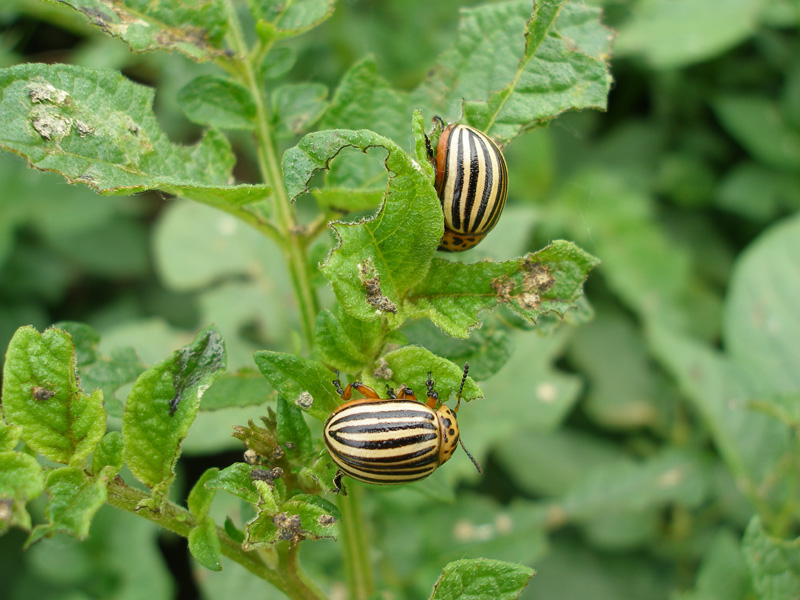
Colorado potato beetle adults on plants
(photo: T. Erlichowski)
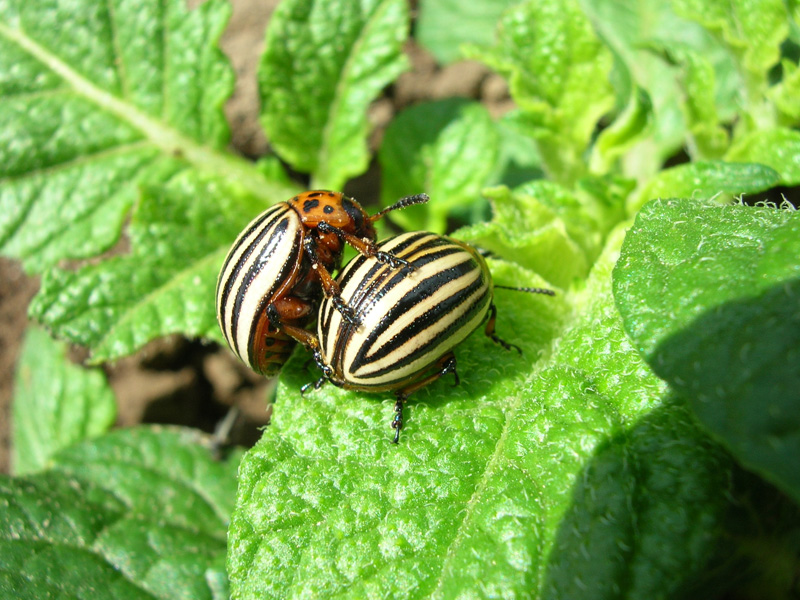
Colorado potato beetle adults on plants
(photo: S. Wróbel)
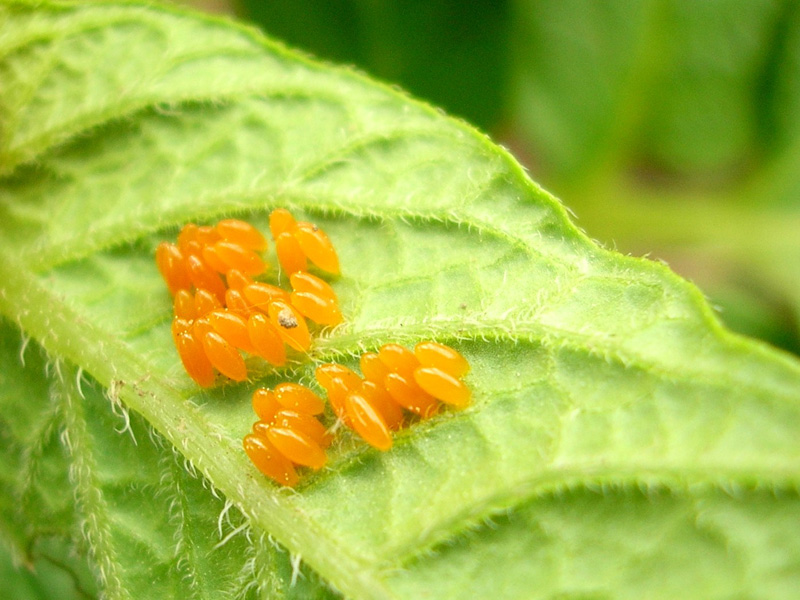
Potato beetle eggs in clusters on the underside of a leaf
(photo: S. Wróbel)
Characteristics and pest description
The Colorado potato beetle has officially been present in Poland since 1946, although isolated outbreaks along the western border were observed earlier, including during World War II. In the absence of effective control and with a large area of potato cultivation at that time, combined with the insect’s high adaptability and reproductive capacity, it was a very difficult pest, causing significant yield losses. It is an invasive pest originating from the USA, from where it spread over 90 years ago to France and has continued to expand across Europe ever since. Currently, it occupies most of the continent, excluding the British Isles and northern regions of Europe.
Biology
- Eggs – small, oval, yellow-orange in color (photo 2A, 2B), laid in clusters of 20-40 (average 20-30 eggs per cluster) on the underside of potato leaves. Egg length is 1.0-1.2 mm, width 0.6-0.8 mm.
- Larvae (harmful stage) – length 1.1 mm (smallest, L1 stage), red in color; as larvae grow, their size increases (largest L4 reach up to 11 mm) and color changes to orange (photo 3A, 3B, 3C, 3D). Larvae pass through 4 instars, differing in body length and head capsule width. Developmental criterion is the head capsule size: L1 0.5-0.6 mm, L2 0.8-1.0 mm, L3 1.3-1.7 mm, L4 2.0-2.5 mm. Head, legs, and pronotum are black. Middle part of the abdomen is thickened.
- Pupa – free type, about 10 mm long, light orange (photo 4A, 4B). Develops in the soil.
- Beetles – body length up to 10 mm in females and 8-9 mm in males (smaller). Sexual dimorphism is visible as a slight indentation on the last abdominal segment in males (ventral side), absent in females. Beetle coloration is yellowish or yellow-orange with 10 longitudinal black stripes on the elytra and irregular spots on the pronotum (photo 1A, 1B). Adult beetles are flying insects, particularly active after overwintering and during spring expansion searching for new plants. Summer generation beetles appear darker (grayish tones) compared to spring-emerged individuals.
Development cycle
The Colorado potato beetle usually completes one generation per year. In warm years or during a warm autumn, a second generation (larvae twice) may appear locally, which often does not complete development. Overwintering stage is the adult beetle, which hibernates in soil at 20-30 cm depth (diapause). A significant portion of beetles die during winter. Mortality depends on overwintering depth, activity level before winter (most vital are deeply overwintering individuals with short activity and females not laying eggs), and biological factors (fungi and entomopathogenic nematodes). First beetle emergence begins in the first decade of May (during the flowering of lilac, broom, and common dandelion) and may last until the end of May, depending on soil temperature (if 14°C is maintained at 20 cm depth for 7 days) and weather conditions. Mass emergence occurs at soil temperatures of 16°C and air temperature of 20°C. During this period, beetles actively search for potato plants for supplemental feeding, then proceed to reproduction and egg-laying. The first eggs are laid from the second decade of May, peaking in early June, but egg-laying may extend at low temperatures. Females lay on average 600-800 eggs in several clusters. Egg development lasts 10-19 days on average. Larvae hatch from June to early July. Larval development lasts 11-30 days with three molts (L4, the most voracious stage, consumes 80% of the total green mass compared to other stages). Peak hatching occurs in the second and third decades of July. Mature L4 larvae descend into soil to 2-5 cm depth and pupate. Pupal stage lasts about 3 weeks. Summer adult beetles appear en masse in late July and August. The last larval hatches from eggs laid by the summer generation feeding intensively on potato plants are sometimes observed in August and early September. Second-generation larvae usually do not complete development and die from cold and lack of food (e.g., technological defoliation or preparation of the plantation for harvest).
Occurrence and damage
Widely and abundantly found throughout Poland, with higher population densities in regions where potatoes are a significant part of crop structure and economic conditions favor small fragmented farms. Highest densities are observed in northwestern, central, and southern regions.
The Colorado potato beetle is a monophagous species (associated with Solanaceae plants). In Poland, apart from potatoes, occasional feeding is observed on tomato, pepper, and eggplant. Larvae have also been found on wild-growing plants, including black nightshade.
This beetle is among the most dangerous potato pests. Adults and larvae (L1-L4) damage all aboveground parts of the plant. Initially, feeding is limited to leaf blades, major leaf veins, and petioles (photo 5A, 5B, 5C). In cases of heavy larval infestation and lack of protection, complete defoliation occurs, leaving only stems (photo 6A, 6B). Consumed green tissue does not contribute to yield, and direct losses can reach 35-40%. In very early cultivars, losses may reach up to 60%. Rarely, late in the season, tubers may be gnawed if exposed in the ridges (photo 7). Monitoring can be done by frequent field observations after planting and during emergence. To detect egg clusters and hatching larvae, direct observation in entomological cages or isolators is also used.
Economic threshold
Potato beetle larvae and adults are controlled after reaching specific damage thresholds. Chemical protection is recommended when one of the following occurs:
- 15 hatched larvae per plant,
- 1 adult beetle per 25 consecutive plants in a row,
- Presence of 1 egg cluster per 10 plants.
Control methods
Basic protection involves the use of insecticides or biological agents (Novodor, Spinor 240 SC) during the growing season. Applications are particularly important during the hatching of L1 and L2 generation larvae, so careful field monitoring is necessary. Control of adults emerging after winter is not commonly practiced in Poland, although product labels and farming practice allow it under specific conditions (e.g., large accumulation of overwintered beetles on young emerging plants). The simplest control method at this stage is seed treatment at planting with the insecticide-fungicide formulation Prestige Forte 370 FS, which acts from emergence, eliminating beetles already feeding on plants (supplemental feeding) before egg-laying. If seed treatment is not used, foliar applications are carried out at the appropriate time of threat.
Chemical control agents for the Colorado potato beetle, classified by chemical groups, act specifically depending on the weather conditions at the time of application. For example, pyrethroid formulations should be applied at temperatures below 20°C on cloudy days without active sunlight (evening sprays preferred). Neonicotinoids can be applied at higher temperatures. Organophosphates can be applied if temperatures are not below 15°C. Ignoring these guidelines reduces or completely inhibits insecticidal efficacy, resulting in ineffective pest control.
Agrotechnical methods (crop rotation, spatial isolation from overwintering sites) do not protect against feeding damage, as beetles can fly long distances in search of even the smallest plantation. Removing Solanaceae weeds, optimal nitrogen fertilization, and eliminating volunteer potatoes only indirectly reduce pest presence. The beetle readily colonizes weakened plants or plantations planted with low-quality seed, so frequent replacement of seed potatoes with healthy certified material (at least every 2-3 years) is recommended.
Compiled by: dr inż. Tomasz Erlichowski