
Polish name: Owies głuchy
Latin name: Avena vatua
English name: Wild-oat
Kod EPPO: AVEFA
Gallery

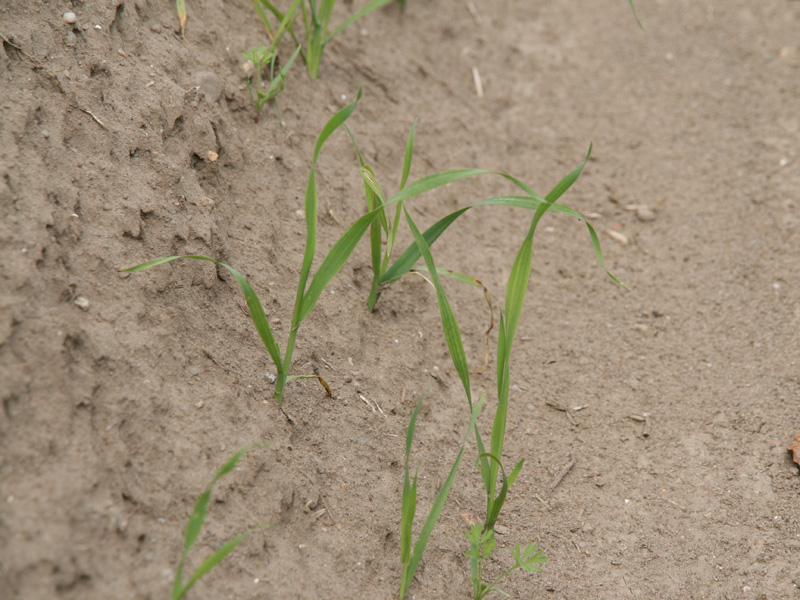
Wild-oat – seedling
(photo: S. Wróbel)
Pest characteristics and description
Wild-oat is an annual spring weed from the monocotyledon class, with seedlings emerging in spring.
A characteristic feature of this species is the narrow, wide first leaf, which is covered with long, spreading hairs along the lower and marginal parts.
It has a fibrous, broom-like root system. The stem is upright, reaching a height of 60 to 120 cm. The first leaf is narrow and wide, with long, spreading hairs on the lower and marginal parts, and its length is 70 to 90 mm. Leaves are narrow, fairly wide; the sheaths of the lower leaves are hairy and have a long leaf ligule. The inflorescence is a loose panicle, composed of two- or three-flowered spikelets, 2–3 mm long, with the lower part of the spikelet axis covered with brown hairs. The fruit is a brown, bristly-haired caryopsis fused with the glumes.
Occurrence and harmfulness
Wild-oat most commonly occurs in spring cereals, flax, legumes, and root crops. It prefers heavier, clay soils with higher pH, wet conditions, and higher nitrogen fertilization. Harmfulness is due to seed shedding into the soil and their potential dispersal by wind.
Control
Mechanical method
The long period between planting and potato emergence is a critical time (ideal conditions for weed development), which can be used for mechanical treatments. These are carried out using available farm machinery, e.g., ridgers, light harrows, cultivators, etc. Their main goal is to create optimal conditions for rapid weed germination and then destroy them with successive tillage operations. The highest effectiveness (over 90%) can be achieved when weeds are at the seedling stage, but effectiveness drops to about 40% as weeds grow. This system's success depends heavily on weather and soil conditions. In very wet springs, mechanical control is difficult. On heavily infested fields, it may even backfire, as damaged couch grass rhizomes may grow stronger and branch more. Mechanical control is also the most labor- and cost-intensive due to multiple passes. This method is mostly used in small farms for self-sufficiency or organic systems. Before potato emergence, 3 to 6 treatments should be performed at 6–8 day intervals. After emergence, the number of cultivations should not exceed 2–3, and delays may damage the crop, increase pathogen transfer via sap, and excessively dry the soil (especially light soils).
Mechanical-chemical method
This is the most efficient and widely used weed control system. It reduces the number of mechanical tillage operations, which are fewer than in the purely mechanical system. Usually, two or three ridgings are done after planting, followed shortly before emergence by herbicide application, after which no further tillage is performed. At this growth stage, identifying weed species can be difficult, so herbicide use should be based on a treatment diary kept by the professional user. It helps determine which weeds may pose a threat in a given field.
Chemical method
The most effective method is herbicide application, which is most effective when the weed is at the seedling stage; the more vigorous the growth, the lower the effectiveness. In potatoes, herbicides are applied in two main timings: pre-emergence and post-emergence. Before applying, always check the herbicide label for instructions and dosage. Some active substances have medium efficacy; results may be unsatisfactory if the weed is dense or at an advanced stage.
On heavily infested fields, a non-selective herbicide containing glyphosate can be applied, the so-called simplified system. Its success depends on weed presence, as glyphosate is absorbed only through leaves and cannot affect potato sprouts (they would be destroyed). Even sprouts just below the soil surface may be damaged (photos A, B). Timing relative to weather, especially temperature and rainfall, is critical. Pre-emergence herbicides applied too late, when potato sprouts are just under the soil, may damage them after heavy rain. Some pre-emergence herbicides can be applied in early growth stages when potato plants are about 5 cm tall, e.g., prosulfocarb + metribuzin.
Active substances for pre-emergence control of wild-oat: metobromuron.
Post-emergence herbicides should be applied no later than crop canopy closure to ensure weed coverage and avoid herbicide retention on potato leaves. All typical monocot herbicides (graminicides) are for post-emergence use. Always follow the label carefully, as efficacy depends on weed growth stage. Usually: couch grass from 2 to 6 leaves, and other monocot weeds (Avena fatua, volunteer cereals, Bromus spp., Poa spp.) from 2 leaves to tillering. Due to pre-harvest intervals, post-emergence herbicides cannot be used in the earliest harvest crops!
Active substances for post-emergence control of wild-oat: propachizafop, clethodim, cycloxydim, fluazifop-P-butyl, quizalofop-P-ethyl.
Compiled by: Dr. Eng. Janusz Urbanowicz