
Polish name: Shepherd’s-purse
Latin name: Capsella bursa-pastoris
English name: Shepherd’s-purse
EPPO code: CAPBP
Gallery

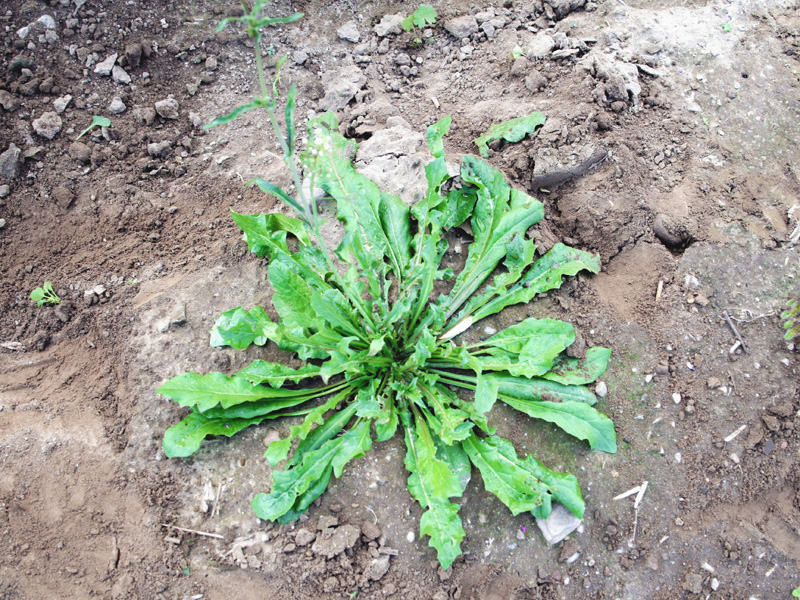
Shepherd’s-purse – leaf rosette
(photo: S. Wróbel)
Characteristics and pest description
Shepherd’s-purse is an annual spring or winter weed from the dicotyledon class, with a spindle-shaped, branched, whitish root system. It germinates in spring, early summer, but also in autumn.
A characteristic feature of this species is the presence of single star-shaped hairs on all leaves. The green parts of the plant can be used as a hemostatic agent.
The stem is usually branched, erect, hairy (rarely bare), 3–60 cm high. Cotyledons are small (2–4 mm), bare, light green, elliptical with a blunt tip. Lower true leaves – elliptical, forming a rosette, and upper leaves – sessile, incised with teeth (star-shaped hairy), less often entire. The inflorescence is a compound raceme of small, white, inconspicuous flowers. The fruit is a triangular-heart-shaped silique, shallowly notched at the tip. Seeds are oblong-oval, flattened, reddish-yellow or yellowish-brown in color.
Occurrence and harmfulness
Shepherd’s-purse most often occurs in cereal crops, root crops (beets and potatoes), gardens, and ruderal sites, where it behaves as a biennial. It is present on almost all soil types but prefers nitrogen-rich, well-aerated, and manure-fertilized loamy and sandy soils.
Its harmfulness is due to high seed production, as a single plant can produce 2,000 to 4,000 seeds, which remain viable in the soil for about 30–40 years. It can produce several generations per year and can germinate at temperatures of 2–5°C. Additionally, it serves as an intermediate host for pests and pathogenic fungi of cruciferous plants.
Control
Mechanical method
The long period from potato planting to emergence is a critical time (ideal conditions for weed development), which can be used for mechanical treatments. These are carried out using machines available on the farm, e.g., ridgers, light harrows, cultivators, etc. Their main task is to create the most favorable conditions for rapid weed germination, followed by destruction through subsequent cultivation treatments. The highest effectiveness (even over 90%) can be achieved when weeds are at the seedling stage, but as weeds grow, effectiveness drops to around 40%. This weed elimination system is highly dependent on weather and soil conditions. In years with very wet springs, mechanical methods are difficult to apply. On heavily infested fields, it may have the opposite effect, as damaged couchgrass runners are stimulated to even stronger growth and branching. Additionally, the mechanical system is the most costly and labor-intensive due to multiple passes. This method is most often used in small farms growing potatoes for self-consumption or in organic systems. Before potato emergence, 3 to 6 treatments should be carried out at 6–8 day intervals. After emergence, the number of cultivations should not exceed 2–3, and any delay increases the risk of crop damage and may spread pathogens with sap, as well as excessively dry the soil (especially light soils).
Mechanical-chemical method
The most advantageous and widespread weed control system. It saves on mechanical cultivation, which is applied much less than in the purely mechanical system. After planting, two or three ridgings are usually performed, followed shortly before emergence by a herbicide treatment, after which no further cultivation is done. At this vegetative stage, identification of weed species can be difficult, so the basis for herbicide application can be a treatment diary, maintained and stored by each professional plant protection user. It allows determining which weed species may pose a threat on a given field.
Chemical method
The most effective method is the use of herbicides, which for this species achieve the highest efficiency when the weed is at the seedling stage; the more vigorous the growth, the lower the effectiveness. Herbicides in potatoes are applied at two basic times: before emergence and after emergence. After deciding to use a herbicide, its label-instructions should be read, which contain information on application timing and doses. Some active substances in herbicides have medium effectiveness (average sensitivity of the weed species), and after their use, the control effect may be unsatisfactory, especially if the specific weed species is abundant or at an advanced growth stage.
On heavily infested fields, a non-selective herbicide containing glyphosate can be applied, called the simplified system. Its success depends on the presence of weeds on the field, as glyphosate is absorbed only through leaves and cannot affect emerging potatoes (they would be destroyed!). Even potato sprouts just below the soil surface may be damaged (photo: A, B). Timing must be carefully adjusted to weather conditions, mainly temperature and rainfall, which often determines high effectiveness. Pre-emergence herbicides applied too late, when potato sprouts are just below the soil surface, can damage them after heavy rainfall. Among pre-emergence herbicides, there are also registered products usable in early growth stages when potato plants are about 5 cm high, e.g., prosulfocarb + metribuzin.
Active substances controlling Shepherd’s-purse for pre-emergence use: chlomazone, flufenacet + metribuzin, fluorochloridone, linuron, linuron + chlomazone, metobromuron, metribuzin, metribuzin + chlomazone, pendimethalin, pendimethalin + chlomazone, prosulfocarb + metribuzin.
Post-emergence herbicides should be applied no later than the stage when plants close in rows, ensuring coverage of weeds and avoiding liquid retention on potato plants. Due to the long pre-harvest interval, post-emergence herbicides cannot be used for the earliest harvest!
Active substances controlling Shepherd’s-purse for post-emergence use: bentazon, metribuzin, and rimsulfuron. Metribuzin applied post-emergence may cause phytotoxic symptoms on certain potato varieties.
Compiled by: Dr. Eng. Janusz Urbanowicz