
Polish name: Maruna bezwonna
Latin name: Matricaria inodora
English name: Scentless chamomile
EPPO code: MATIN
Gallery

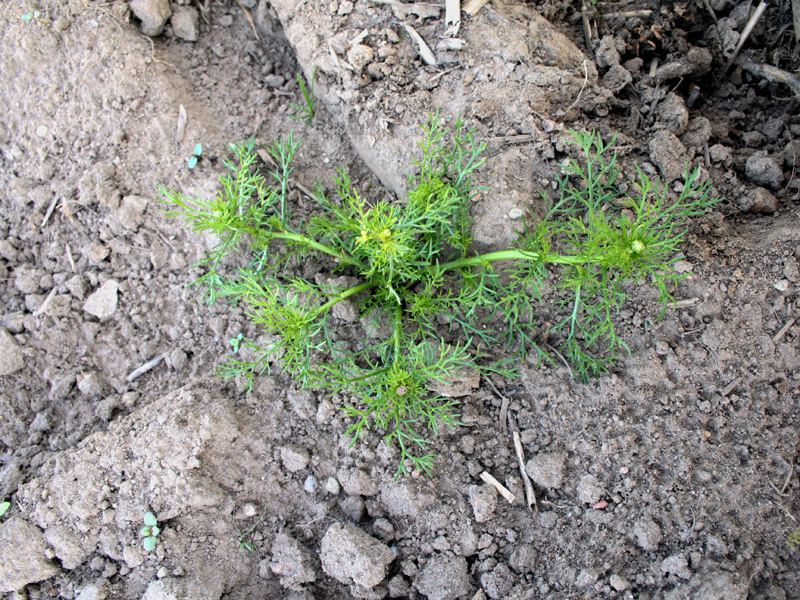
Scentless chamomile – seedling
(photo: S. Wróbel)
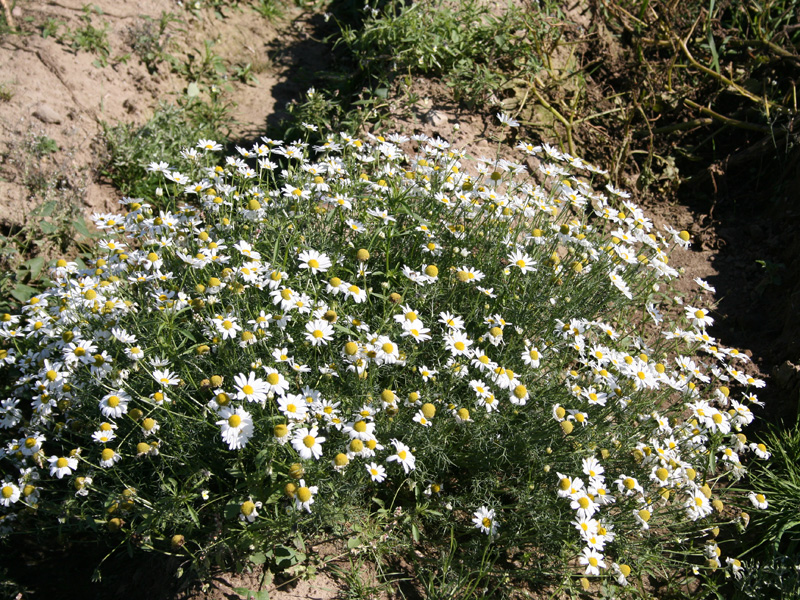
Scentless chamomile
(photo: S. Wróbel)
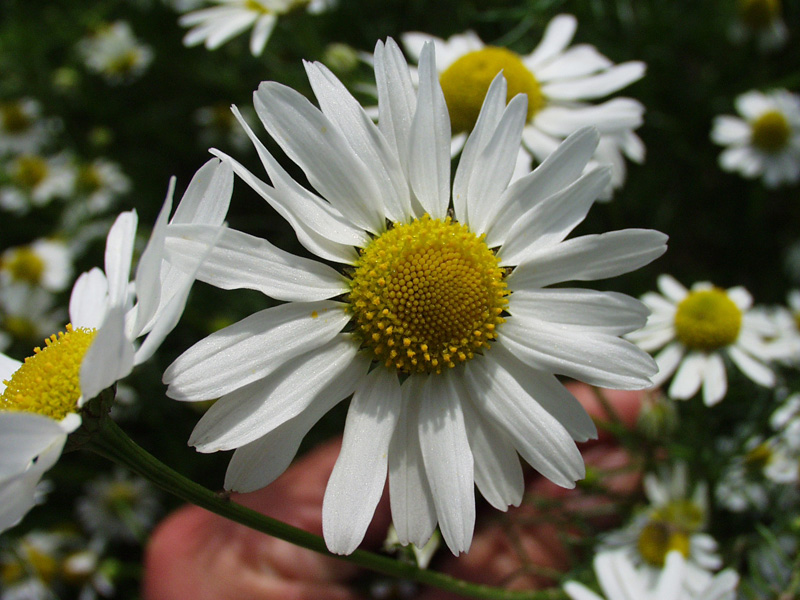
Scentless chamomile – flower
(photo: S. Wróbel)
Characteristics and pest description
Scentless chamomile is an annual, biennial, or perennial dicotyledonous weed, with seedlings appearing in spring and autumn.
A characteristic feature of this species is the lack of scent when leaves and stems are crushed. The flower heads have a full base.
It has a thin, spindle-shaped root system. The stem is 15 to 60 cm high, roundish, branched from the middle, and hairless. Cotyledons are elliptical, 3-4 mm long, small, hairless, green, rounded at the tip. True leaves are bi- or tripinnate, with narrowly lanceolate segments, a broader segment at the tip, fleshy. The inflorescence is a flower head on an elongated peduncle. Marginal flowers are white and ligulate, inner flowers are yellow and tubular with a filled, conical floral base. The fruit is a dark brown, prismatic achene, truncated at the tip. Seeds are irregular, dark brown, germinating at 5-35°C.
Occurrence and harmfulness
Scentless chamomile occurs in cereal and root crops, rapeseed, permanent grasslands, and ruderal sites. It is present on various soil types but prefers warm, loamy, and sandy soils, rich in nutrients, humus-rich, moist, and low in calcium.
Its harmfulness lies in its very high seed production; one plant can produce up to 100,000 seeds, which remain viable for 6 years. It heavily infests crops and can germinate almost year-round.
Control
Mechanical method
The long period from planting to potato emergence is critical (ideal conditions for weed development) and can be used for mechanical treatments. These are performed using farm machinery, e.g., ridgers, light harrows, hoeing machines, etc. Their main task is to create optimal conditions for rapid weed germination and then destroy them with subsequent cultivation treatments. The highest effectiveness (even over 90%) is achieved when weeds are at the seedling stage, but effectiveness drops to about 40% as weeds grow. This system heavily depends on weather and soil conditions. In very wet springs, mechanical methods are difficult to apply. On heavily infested fields, it can have the opposite effect as damaged couchgrass rhizomes are stimulated to even stronger growth and branching. Additionally, the mechanical system is the most labor- and cost-intensive due to multiple passes. This method is usually used on small farms growing potatoes for self-sufficiency or in organic systems. Before potato emergence, 3 to 6 treatments should be performed at 6-8 day intervals. After emergence, the number of cultivations should not exceed 2-3, and any delay may damage the crop and increase the risk of pathogen transfer with sap, potentially over-drying the soil (especially light soils).
Mechanical-chemical method
The most advantageous and widespread weed control system. It reduces the number of mechanical cultivations compared to the purely mechanical system. After planting, usually two or three ridgeings are performed, followed shortly before emergence by a herbicide treatment, after which no further cultivations are done. During this vegetative phase, identifying weed species can be difficult, so a treatment log kept by each professional pesticide user serves as the basis for herbicide application. It helps determine which weed species may pose a threat in a given field.
Chemical method
The most effective control method is the use of herbicides, which are most effective when weeds are at the seedling stage; effectiveness decreases as the weed grows. Herbicides in potatoes are applied at two main timings: pre-emergence and post-emergence. Before using a herbicide, the label and instructions must be consulted for timing and dosage. Some active ingredients have medium efficacy, and results may be unsatisfactory if the weed is abundant or in an advanced growth stage.
On heavily infested fields, a non-selective herbicide containing glyphosate may be used, known as the simplified system. Its success depends on the presence of weeds, as glyphosate is absorbed only through leaves and must not contact potato shoots. Even potato sprouts just below the soil surface can be damaged (photos A, B). Proper timing according to weather conditions, mainly temperature and rainfall, is critical for high effectiveness. Pre-emergence herbicides applied too late, when sprouting potatoes are just below the soil surface, can damage the crop after heavy rainfall. Some pre-emergence herbicides can also be applied in early potato growth stages, e.g., prosulfocarb + metribuzin.
Active ingredients for pre-emergence control of scentless chamomile: fluorochloridon, flufenacet + metribuzin, linuron + chlormazon, metobromuron, metribuzin, metribuzin + chlormazon, pendimethalin, prosulfocarb + metribuzin.
Post-emergence herbicides should be applied no later than canopy closure, ensuring coverage of weeds without accumulating spray on potato plants. Due to the long pre-harvest interval, post-emergence herbicides cannot be used for early harvest.
Active ingredients for post-emergence control of scentless chamomile: bentazon, metribuzin, rimsulfuron. Metribuzin applied post-emergence may cause phytotoxic symptoms on some potato varieties.
Compiled by: Dr. Eng. Janusz Urbanowicz