
Nazwa polska: Pchełki ziemniaczane
Nazwa łacińska: Epitrix sp, Epitrix cucumeris, E. similaris
Nazwa angielska: Potato flea beetle
EPPO code: EPIXSP
Class: Insects (Insecta)
Order: Beetles (Coleoptera)
Family: Leaf beetles (Chrysomelidae)
Subfamily: Flea beetles (Alticinae)
Gallery

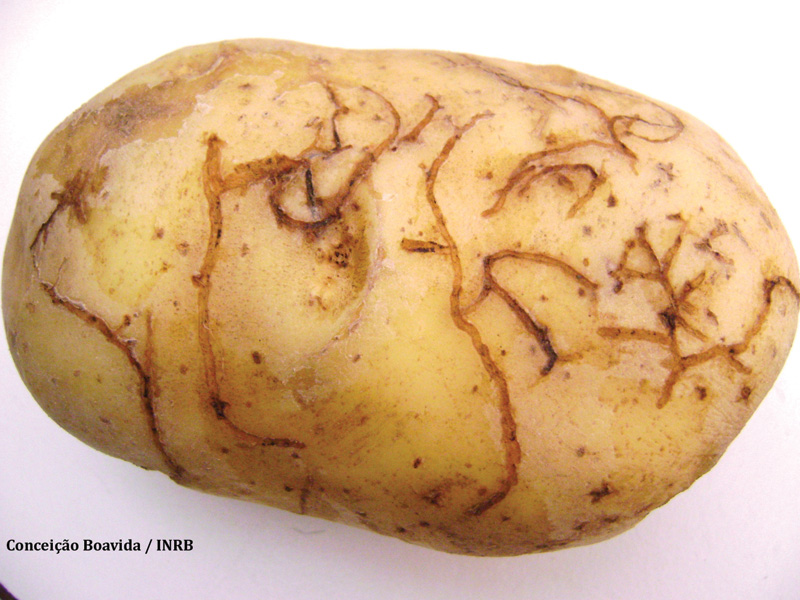
Damaged tuber with dense feeding galleries just under the skin
(photo: Bpavida, INRB)
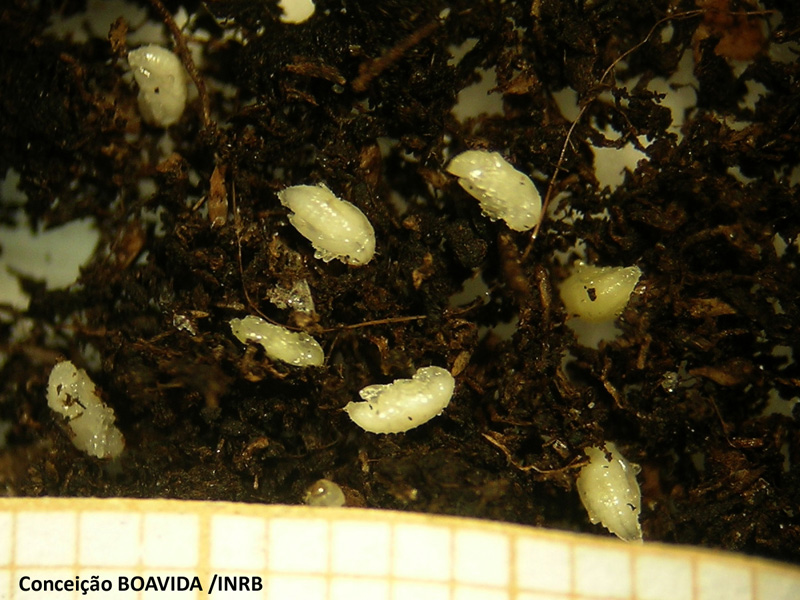
Epitrix sp. pupae in the soil
(photo: Bpavida, INRB)
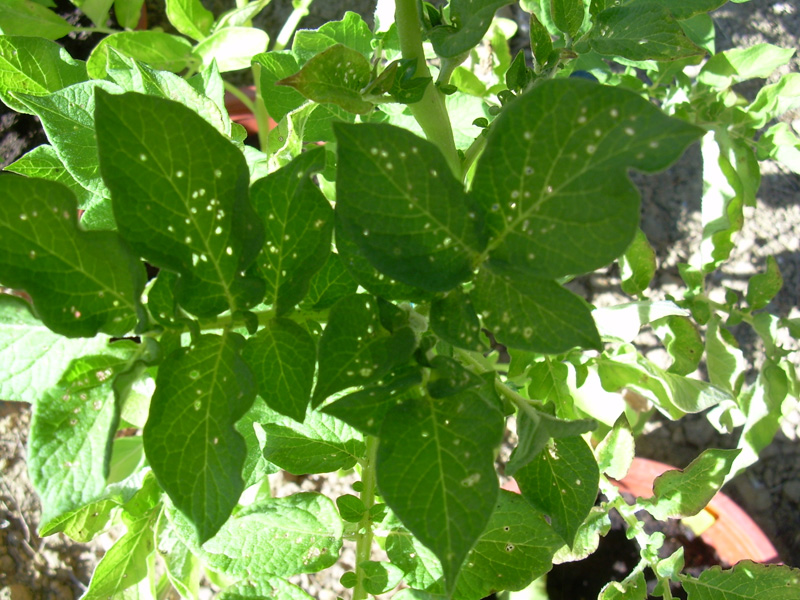
Damage caused by beetles on leaves
(photo: Bpavida, INRB)
Characteristics and description of the pest
Potato flea beetles are invasive pests originating from North America. They are listed as A2 quarantine pests by EPPO. They likely arrived from the Azores, where they were previously present, or with seed material or soil. They were first observed on the European continent in Portugal in 2004, in the northern part, and have been present in potato fields since 2008. In Spain, they have been found in potato fields since 2010. This is a new species, so it is likely acclimating in the region and may spread across Europe in the future. The most harmful species for potatoes are three, two of which were introduced to Europe – Epitrix cucumeris and Epitrix similaris. In North America, their native region, Epitrix tuberis is also harmful.
Biology
- Eggs – small, white, spherical, laid at the base of plants; development takes 35-55 days.
- Larvae – whitish with a brown head (5 mm long), damaging roots and tubers (photo 2) by creating shallow tunnels under the skin.
- Pupa – free-type (photo 3), pupation occurs in soil.
- Beetles – small, black (1.5-2 mm long), agile and fast, with the characteristic hind leg femur enlargement of this subfamily, allowing them to jump long distances (like a flea). Morphological similarity among Epitrix sp. species is very high, and identification to a specific species requires an expert (photo 1). The beetle is flying, especially active after overwintering and during spring expansion in search of new host plants.
Life cycle
Potato flea beetles usually develop one generation per year. For E. cucumeris and E. similaris, there is one generation per growing season. Adults overwinter in the soil and emerge in spring, in May or early June. Females then search for host plants and lay eggs at the base of the plant in the soil, about 180 eggs per female (in groups of 15 eggs). Egg-laying lasts 35-55 days. Larvae hatch 7-14 days after egg-laying. Larvae damage roots and tubers for the next 4 weeks. Pupation occurs in soil (4-10 days), after which adults emerge and damage leaves, creating shot-hole-like perforations. Some enter diapause and overwinter. The temperature preferences of Epitrix spp. in their native range (USA, Canada) match the European climate, as these climates are very similar. For E. cucumeris, population development on potato and tomato fields in central and northern Europe can be expected.
Distribution and damage
The flea beetle is monophagous (associated with Solanaceae plants). This pest prefers potatoes and other Solanaceae hosts (tomato, eggplant, pepper, tobacco) and Solanaceae weeds. Adults occasionally cause defoliation in plants from Chenopodiaceae, Cucurbitaceae, and Fabaceae. In the USA, Epitrix sp. has economic significance not only for potato crops but also for field-grown tomatoes. This may also become relevant for Poland, increasing the economic importance of the pest.
Damage is very characteristic. Adults create a network of small, numerous holes in leaves, 1-1.5 mm in diameter (photo 4), resembling target shooting holes (shot-hole). The pest is economically important especially during mass outbreaks in hot, dry years (defoliation losses may reach 15% of yield). Larvae damage potato tubers, creating tunnels under the skin up to 0.5-1 cm deep; these sites may secondarily be infected by bacterial and fungal diseases (photo: [foto_link:2|2]).
Economic threshold
Undefined
Control methods
Basic protection where Epitrix sp. occurs involves foliar and soil insecticide applications. However, under local conditions, this is a quarantine pest that is not present. Additionally, no registered control products are available in Poland.
Compiled by: Dr. Tomasz Erlichowski