
Polish name: Ostrożeń polny
Latin name: Cirsium arvense
English name: Creeping thistle
EPPO code: CIRAR
Gallery

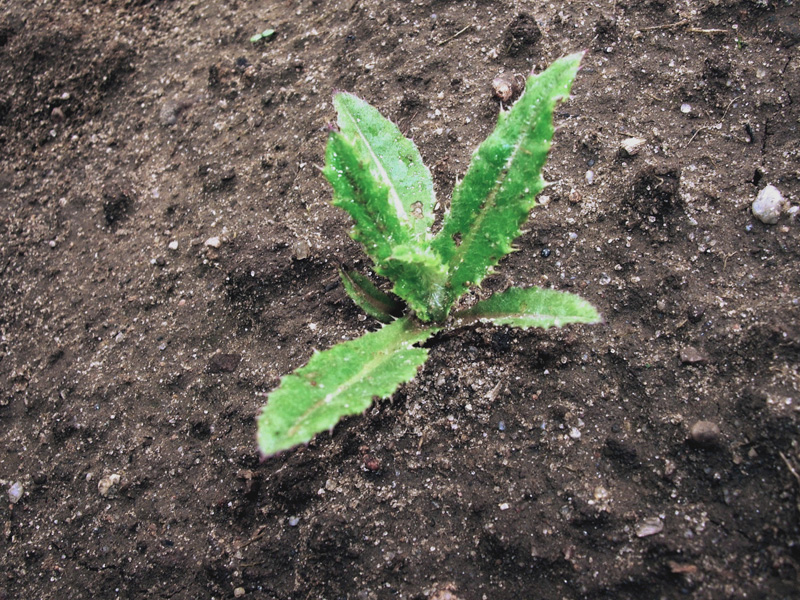
Cirsium arvense – seedling
(photo: S. Wróbel)
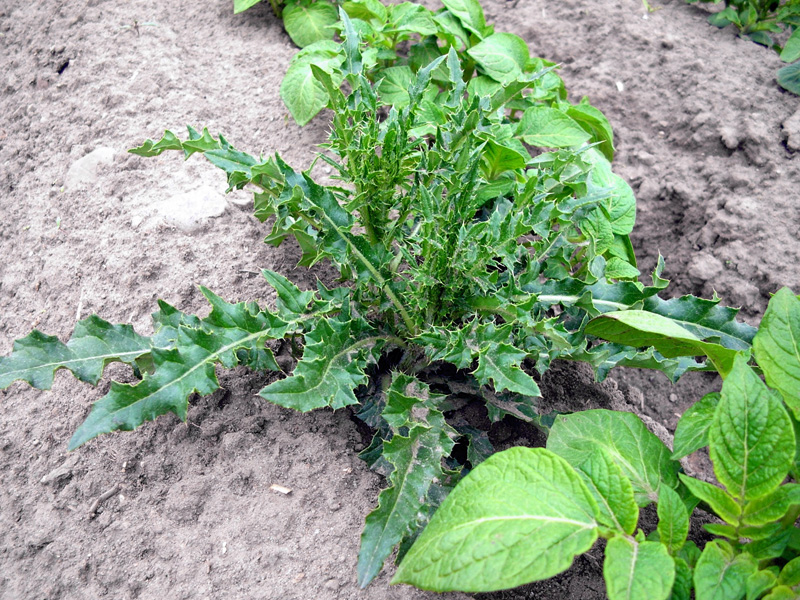
Creeping thistle
(photo: S. Wróbel)
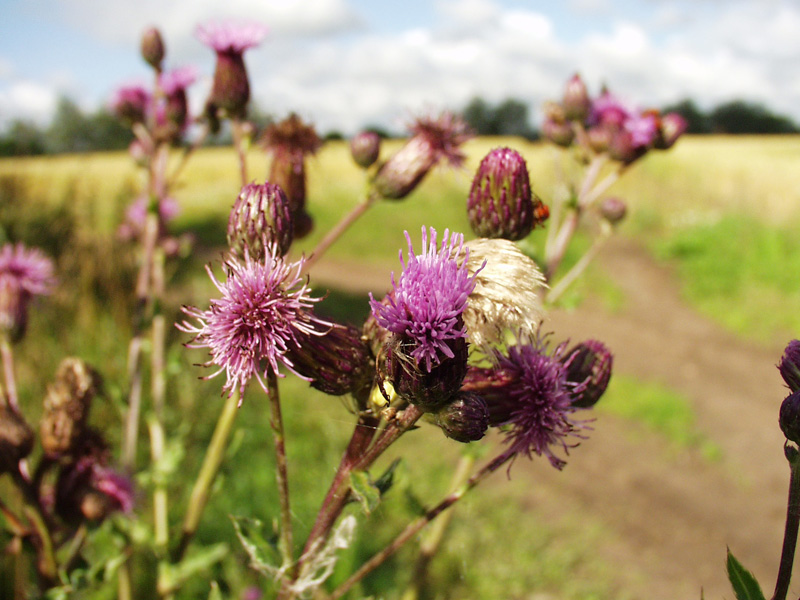
Creeping thistle – inflorescence
(photo: S. Wróbel)
Characteristics and Description of the Pest
Creeping thistle is a perennial, dioecious weed from the dicotyledon class, with seedlings and root shoots appearing in spring. A characteristic feature of this species is the clearly visible large, spiny teeth along the leaf margins.
It has a deep (2–6 m), highly branched, cylindrical root of yellowish-white or yellowish-brown color. The stem, 40–120 cm tall, is woolly, highly branched, gray-green, hairless, slightly hairy at the top.
Cotyledons can vary in shape: elliptical or lanceolate, with variable hairiness; they are green on top, grayish underneath, and strongly spiny-toothed. The inflorescence is a capitulum composed of separate-sexed, light purple or pinkish-purple flowers. The fruit is a light beige wedge-shaped achene with a feathery calyx hair. Seeds are oval, elongated.
Occurrence and Harmfulness
Creeping thistle occurs in all crops, along field margins, roadsides, and ruderal sites. It is present on almost all soil types, except the poorest ones. Its harmfulness lies in its strong depletion of soil nutrients. It is highly fertile; when propagated by seeds, it produces only a leaf rosette in the first year. Vegetatively, it can reproduce even from small fragments of rhizomes. Leaving a growing thistle on 4.5 m² can lead to infestation of up to 50 hectares of crops in subsequent years.
Control
Mechanical Method
The period between planting and potato emergence is critical (ideal conditions for weed growth) and can be used for mechanical treatments. These are performed using available farm machinery, e.g., ridgers, light harrows, hoes, etc. Their main goal is to create favorable conditions for rapid weed germination, followed by destruction through subsequent tillage. Maximum effectiveness (over 90%) is achieved when weeds are in the seedling stage; as they grow, effectiveness drops to about 40%. This system heavily depends on weather and soil conditions. In very wet springs, mechanical control is difficult to apply. On heavily rhizomatous fields, it may have the opposite effect, as damaged rhizomes stimulate even stronger growth. Additionally, it is labor- and cost-intensive due to multiple passes. It is mainly used in small farms for self-supply or organic systems. Before potato emergence, 3–6 passes should be made at 6–8 day intervals. After emergence, no more than 2–3 passes should be made to avoid plant damage and excessive soil drying.
Mechanical-Chemical Method
This is the most widely used system of weed control. It reduces the need for mechanical tillage. After planting, usually 2–3 mechanical passes are performed, followed shortly before emergence by herbicide application. At this stage, identification of weed species can be difficult; hence, a treatment diary is essential to determine which weeds may pose a threat.
Chemical Method
The most effective method is herbicide use. Maximum efficacy is achieved when the weed is at the seedling stage; effectiveness decreases with more developed plants. Herbicides in potatoes are applied pre-emergence or post-emergence. Users must follow label instructions for timing and dosage. Some active substances have medium effectiveness; results may be unsatisfactory for dense or advanced weed growth.
On heavily infested fields, a non-selective herbicide containing glyphosate may be used (simplified system). Its success depends on weed presence, as glyphosate is absorbed through leaves only. Potato sprouts near the soil surface can be damaged. Proper timing with regard to weather—temperature and rainfall—is critical. Pre-emergence herbicides applied too late may damage emerging potatoes. Some pre-emergence substances can also be applied when potatoes reach ~5 cm height, e.g., prosulfocarb + metribuzin.
Active substances for pre-emergence control of creeping thistle: linuron + chlormazon. For post-emergence control: rimsulfuron.
Compiled by: Dr. Eng. Janusz Urbanowicz