
Polish name: Potato cyst nematode, Aggressive nematode
Latin name: Globodera rostochiensis, G. pallida
English name: Golden potato cyst nematode, White potato cyst nematode
EPPO code: HETDRO, HETDPA
Type: Nematodes (Nematoda)
Class: Secernentea
Order: Tylenchida
Family: Heteroderidae
Key species:
- Golden potato cyst nematode – Globodera rostochiensis, EPPO code: HETDRO
- White potato cyst nematode – Globodera pallida, EPPO code: HETDPA
Gallery

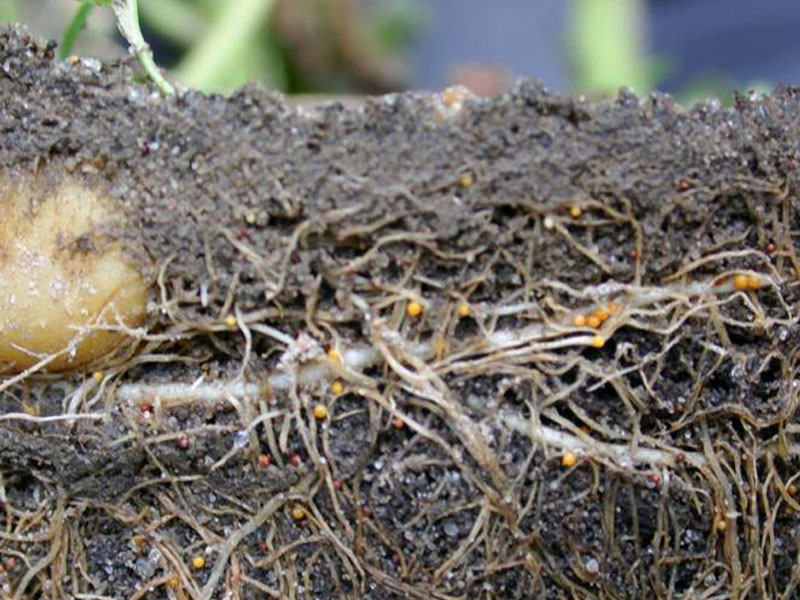
Cysts of potato cyst nematode on potato roots
(photo: IHAR Bydgoszcz)
Characteristics and description of the pest
Characteristics and description of the pest
The potato cyst nematode and the pale cyst nematode are highly dangerous quarantine pests of potato. They originate from the Andes in South America and were likely introduced to Europe in the 19th century, later spreading to other continents with seed potatoes. Earlier descriptions referred to Heterodera rostochiensis. In 1973, a new species forming cysts on potatoes was described (Heterodera = Globodera pallida). The primary host plant is potato, but tomato and eggplant can also be affected. There are 5 pathotypes of G. rostochiensis (Ro1-Ro5) and 3 pathotypes of G. pallida, with a European system for pathotype classification. Undiscovered pathotypes may still exist in the Andes. Pathotypes differ in reproductive ability on specific potato varieties. Variety resistance is detailed in their descriptions.
Bionomics
- Eggs – very small and numerous, found in cysts (dead females). Each cyst may contain up to 700 eggs with embryos ready to hatch.
- Larvae (harmful stage) – colorless. Invasive larvae are ~0.4 mm long. They hatch in spring, invade potato roots, and feed in “giant cells.” Female larvae swell and molt, breaking the root epidermis and appearing as yellow spheres (cysts).
- Adults (harmful stage) – female cysts are nearly spherical (lemon-shaped) with a “neck” attached to the root, measuring 0.6–0.8 mm long and 0.4–0.6 mm wide. Males are threadlike, 0.9–0.2 mm, moving freely in soil to fertilize females. Adult female cysts overwinter in soil with live eggs inside.
Life cycle
Optimal soil temperature for potato cyst nematode development is 12°C; at 15–20°C, massive larval hatching occurs. Larvae hatching from cysts are stimulated by potato root exudates. Only ~40% of larvae hatch in the first year. Viable cysts with eggs can persist in soil for many years. Populations decline over time if non-host crops are grown. Larvae invade root tips, forming giant cells. Female larvae swell, molt, and emerge as yellow spheres attached to roots, while males leave roots and fertilize females. Eggs develop in females, and cysts turn brown after female death but still contain live eggs. One generation occurs per year.
Distribution and harmfulness
This pest may occur throughout the country, with highest populations on monoculture potato fields and susceptible varieties. Initial symptoms appear in spring weeks after emergence: stunted plants, yellowing, curling, and wilting leaves, with local patches of affected plants. Severely infected plants die. By mid-July, white or yellow cysts are visible on roots (photo 1). Infected plants produce additional roots (“beard”). Tubers are small, underdeveloped, often infected by other pathogens, and yield losses may reach 80%. Potato cyst nematode is a quarantine organism requiring official control.
Both G. rostochiensis (potato cyst nematode) and G. pallida (pale cyst nematode) form cysts on potato. G. pallida cysts are white, unlike the yellow cysts of G. rostochiensis. Both species have pathotypes in Europe: Ro1-Ro5 for G. rostochiensis and Pa1-Pa3 for G. pallida. Pathotypes pose additional risk for breeding resistant varieties. Ro1 is most common locally; resistance to other pathotypes is under study.
Economic threshold
The economic threshold for potato cyst nematode is 10 cysts with live larvae per 1 g of soil.
Control methods
As a quarantine pest, both external and internal quarantine regulations apply. Potato movement from infested areas is prohibited. Clean machinery and tools thoroughly and remove infected plants. Agronomic control through crop rotation with non-host plants reduces nematode populations but works slowly. Remove solanaceous weeds, perform deep winter plowing, and allow a 4–5 year break in potato cultivation on the same field. The most effective and economical control method is planting certified healthy material and cultivating nematode-resistant varieties (link), which reduces nematode density by 60–91% per year, supported by chemical control using nematicides (Nemathorin 10 GR).
Compiled by: Dr. Tomasz Erlichowski