
Polish name: Galinsoga parviflora
Latin name: Galinsoga parviflora
English name: Gallant soldier
EPPO code: GASPA
Gallery

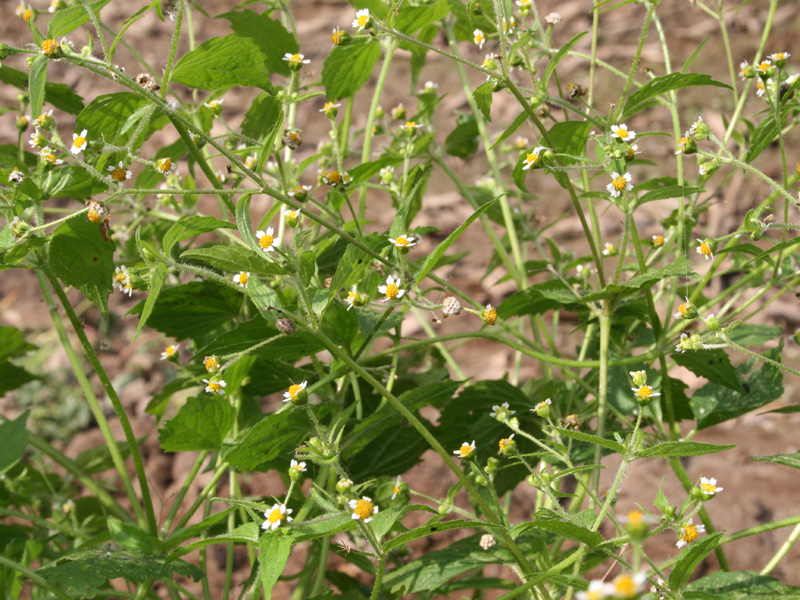
Gallant soldier – inflorescences
(photo: S. Wróbel)
Characteristics and pest description
Gallant soldier is an annual summer weed from the dicot class, and since it is a thermophilic species, emergence occurs only in mid-May and continues throughout the growing season.
A characteristic feature of this species is the strongly glossy, clearly light green cotyledons.
It has a taproot system with numerous lateral branches. The stem reaches a height of 10 to 40 cm, is roundish, strongly branched, and appressed-hairy. Cotyledons are ovate, 15 to 20 mm long, glabrous, glossy, light green, with a slight notch at the tip. Lower true leaves – ovate, opposite, and upper – lanceolate, light green, toothed, with slight hairiness. The inflorescence is an umbel-shaped cluster of flower heads on long peduncles. Marginal flowers – ligulate, white (usually 5), and inner flowers – tubular, yellow (35 to 40), arranged in an umbel-shaped cluster, made of small white flowers with yellow stamens. The fruit is a hairy, four-angled achene, black in color. Seeds are black and roundish.
Occurrence and Harmfulness
Gallant soldier most often occurs in gardens and in root crop fields, and less frequently in cereals. It prefers clayey and light, humus-rich soils abundant in nitrogen. Harmfulness lies in its ability to produce several generations in one year (full development takes 4 to 6 weeks!). One plant can produce up to 300,000 fruits. Even after being pulled out, it can root again, but it is very sensitive to low temperatures. Seeds may mature even after the plant has been removed from the soil and are frost-resistant.
Control
Mechanical method
The long period from planting to potato emergence is a critical period (ideal conditions for weed development) that can be used for mechanical treatments. They are carried out using available farm machinery, e.g., ridgers, light harrows, hoes, etc. Their main task is to create the most favorable conditions for rapid weed germination, followed by destruction through subsequent cultivation. Maximum effectiveness (even over 90%) can be achieved when weeds are at the seedling stage, but as weeds develop, effectiveness drops to about 40%. This system of weed elimination is highly dependent on weather and soil conditions. In years with very wet spring, the mechanical method is difficult to apply. In heavily infested fields, it may have the opposite effect, as damaged couch grass rhizomes are stimulated to even stronger growth and branching. Additionally, the mechanical system is the most costly and labor-intensive, due to multiple passes. This method is most often used on small farms, where potatoes are grown for self-sufficiency, and in organic systems. Before emergence of potatoes, 3 to 6 treatments should be performed at intervals of 6–8 days. After emergence, the number of cultivations should not exceed 2–3, and any delay increases the risk of crop damage, pathogen transfer with sap, and excessive soil drying (especially light soils).
Mechanical-chemical method
The most favorable and widely used weed control system. It allows saving on mechanical cultivation, which is used much less than in the purely mechanical system. After planting, two or three ridgings are usually performed, followed shortly before emergence by a herbicide treatment, after which no further cultivation is done. At this growth stage, identifying occurring weed species can be difficult, so herbicide application can be based on a treatment log, which should be maintained and stored by every professional plant protection product user. This log allows determining which weed species may pose a threat in a given field.
Chemical method
The most effective method is the use of herbicides, which for this species achieve the highest effectiveness when the weed is in the seedling stage; the more vigorous the growth, the lower the effectiveness. Herbicides in potatoes are applied at two main times: before emergence and after emergence. After deciding to use a herbicide, its label-instruction should be consulted, containing information on timing and doses. Some active substances in herbicides have medium effectiveness (average sensitivity of the weed species), and after application, the control effect may be unsatisfactory, especially if the weed is highly abundant or in an advanced growth stage.
In heavily infested fields, a non-selective herbicide containing glyphosate can be applied, which is a so-called simplified system. Its success depends on the presence of weeds in the field, as glyphosate is absorbed only through leaves and cannot contact potato sprouts (they would be destroyed!). Even potato sprouts just below the soil surface can be damaged (photo A, B). It is crucial to adjust the timing to weather conditions, mainly temperature and rainfall, which often determines high effectiveness. Pre-emergence herbicides applied too late, when potato sprouts are just under the soil surface, after heavy rain, may damage them. Registered pre-emergence herbicides can also be applied in early growth stages, e.g., prosulfocarb + metribuzin.
Active substances controlling gallant soldier for pre-emergence use: fluorochloridon, linuron, linuron + chlomazon, metobromuron, metribuzin, prosulfocarb + metribuzin.
Herbicides applied post-emergence should be used no later than the row closure stage, ensuring coverage of weeds and preventing the working fluid from pooling on potato plants. Due to the long pre-harvest interval, post-emergence herbicides cannot be used in early-harvest crops!
Active substances controlling gallant soldier for post-emergence use: bentazon and metribuzin. Post-emergence metribuzin may cause phytotoxicity symptoms on some potato varieties.
Compiled by: dr inż. Janusz Urbanowicz