
Polish name: Fiołek polny
Latin name: Viola arvensis
English name: Field pansy
EPPO code: VIOAR
Gallery

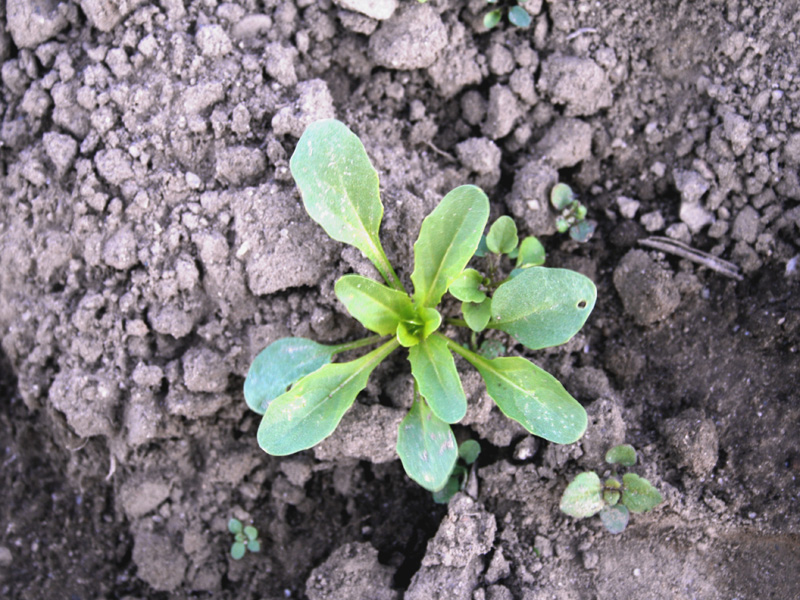
Field pansy – seedling
(photo: S. Wróbel)
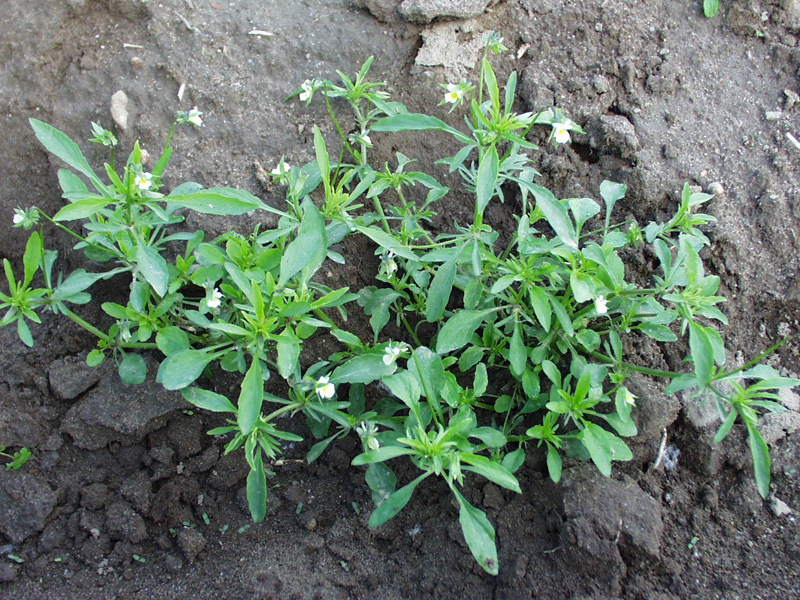
Field pansy
(photo: S. Wróbel)
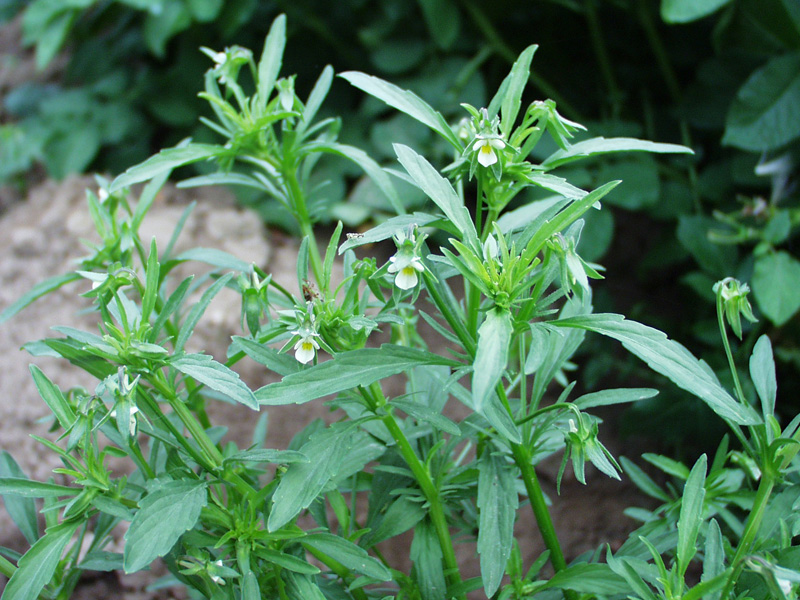
Field pansy – flower
(photo: S. Wróbel)
Characteristics and Description of the Pest
Field pansy, also known as wild pansy, is an annual weed, either spring- or winter-emerging, belonging to the dicotyledon class, which germinates in autumn and spring.
A distinctive feature of this species is the presence of notches on the leaves; the older the leaf, the more pronounced the notches.
It has a taproot system, spindle-shaped. The stem is erect or branched, 10 to 30 cm high. Cotyledons are small (4-5 mm), glabrous, ovate, green on the upper side, and with a purple coating underneath, both sides obliquely cut. The lower true leaves are ovate and opposite, while the upper leaves are lanceolate with characteristic long stipules (of the same length as the leaf). It does not produce an inflorescence; flowers are solitary on long peduncles, whitish-yellow with a slight violet tint. The fruit is a three-chambered capsule, splitting longitudinally. Seeds are elongated-ovate, shiny, and dark yellow or light brown.
Occurrence and Harmfulness
Field pansy is most commonly found in cereal crops, rapeseed (winter crops), root crops (beets and potatoes), and gardens. It occurs on almost all soil types but prefers calcium-poor, moderately acidic soils.
Its harmfulness lies in its high fecundity, as one plant can produce up to 2,500 seeds, which retain high germination potential in the soil. Its presence intensifies in crop rotations with a high proportion of cereals and in monocultures. Splitting seed capsules can disperse seeds over long distances, and seeds can also be carried by ants.
Control
Mechanical Method
The long period between planting and potato emergence is a critical time (ideal conditions for weed development), which can be used for mechanical treatments. These are carried out using farm machinery such as hilling machines, light harrows, cultivators, etc. Their main task is to create favorable conditions for rapid weed germination, followed by destruction through subsequent cultivation operations. Maximum effectiveness (even over 90%) is achieved when weeds are at the seedling stage, but effectiveness drops to about 40% as weeds grow. This system heavily depends on weather and soil conditions. In very wet springs, mechanical control is difficult. In heavily couch-grass-infested fields, it may backfire, as damaged rhizomes are stimulated to grow and branch more. Additionally, the mechanical system is the most labor- and cost-intensive due to multiple passes. It is most often used in small farms for self-sufficiency or organic systems. Before potato emergence, 3 to 6 treatments at 6-8 day intervals should be performed. After emergence, no more than 2-3 treatments should be applied, as delays increase the risk of crop damage and pathogen transfer via sap, and may excessively dry the soil (especially light soils).
Mechanical-Chemical Method
This is the most effective and widely used weed control system. It reduces the number of mechanical operations compared to the purely mechanical system. After planting, usually two or three hilling operations are performed, followed shortly before emergence by a herbicide treatment, after which no further cultivation is done. At this growth stage, identifying the weed species present can be difficult, so herbicide use can be based on a treatment log, maintained by every professional user of plant protection products, to determine which weeds may pose a threat in a given field.
Chemical Method
The most effective method is the use of herbicides, which are most effective when the weed is at the seedling stage; the more vigorous the growth, the lower the effectiveness. In potatoes, herbicides are applied at two main times: pre-emergence and post-emergence. Before use, always consult the herbicide label for recommended timing and dosage. Some active ingredients have medium effectiveness (average sensitivity of the weed species), and control may be unsatisfactory if the species is abundant or in advanced growth stages.
In heavily infested fields, a non-selective herbicide containing glyphosate may be applied, known as a simplified system. Its success depends on the presence of weeds, as glyphosate is only absorbed through leaves and must not contact emerging potatoes (which would be destroyed). Even potato sprouts just under the soil surface can be damaged (photo A, B). Timing relative to weather conditions, mainly temperature and rainfall, is critical for effectiveness. Pre-emergence herbicides applied too late, when potatoes are just below the soil surface, can be damaged by heavy rainfall. Some pre-emergence herbicides can still be applied in early potato growth (around 5 cm), e.g., prosulfocarb + metribuzin.
Active ingredients for pre-emergence control of field pansy: flufenacet + metribuzin, linuron + chlormazon, metobromuron, metribuzin, metribuzin + chlormazon, pendimethalin, pendimethalin + chlormazon, prosulfocarb + metribuzin.
Post-emergence herbicides should be applied no later than the row closure stage to ensure complete coverage of weeds and prevent herbicide retention on potato plants. Due to long pre-harvest intervals, post-emergence herbicides cannot be used in early harvest crops.
Active ingredients for post-emergence control of field pansy: metribuzin. When applied post-emergence, it may cause phytotoxic symptoms in some potato varieties.