
Polish name: Common mugwort
Latin name: Artemisia vulgaris
English name: Mugwort
EPPO code: ARTVU
Gallery

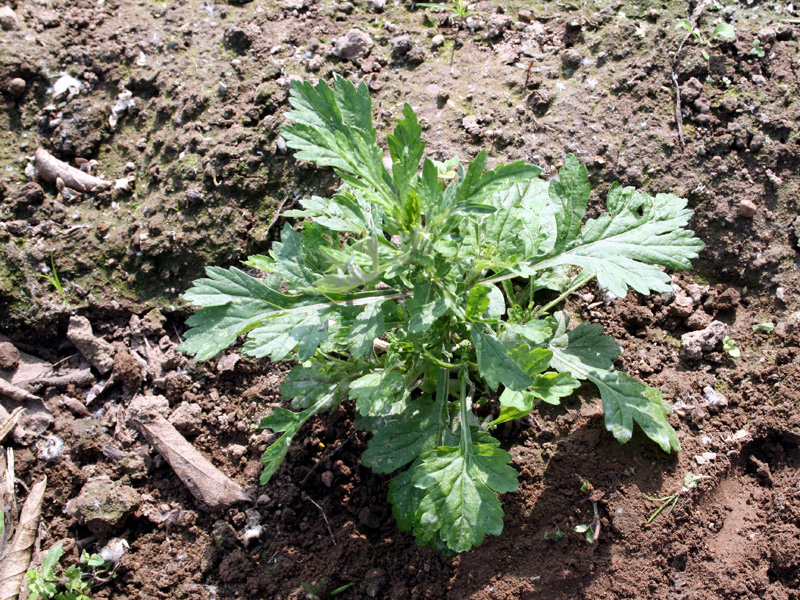
Common mugwort – seedling
(photo: S. Wróbel)
Characteristics and description of the pest
Common mugwort is an annual or perennial weed belonging to the dicotyledonous class.
A characteristic feature of this species is its erect, branched, reddish-tinged stem.
It has a strongly branched, “creeping” root system. The stem is 50 to 200 cm tall, erect, branched, reddish-tinged, glabrous at the base and shortly hairy in the upper part.
The cotyledons are oval, rounded, sessile, with a narrowed base, small, about 3 mm long, glabrous. The lower true leaves are petiolate, pinnately divided with lanceolate, sharp segments; the middle and upper leaves are sessile, and the highest ones are undivided and short. Leaf margins are rolled under; the upper surface is glabrous and dark green, while the underside is white-woolly. The inflorescence is a panicle composed of yellow to reddish-brown flower heads borne on short peduncles. The fruit is an oblong achene, rounded or flattened, grayish-brown in color with silvery streaks.
Occurrence and harmfulness
Common mugwort occurs mainly in cereal and maize crops, and less frequently in root crops. It is found on loamy and clay soils rich in mineral nutrients.
Its troublesome nature is associated with the ability to reproduce vegetatively and spread from field margins and borders into cultivated fields.
Control
Mechanical method
The long period from planting to potato emergence is a critical time (ideal conditions for weed development) that can be used for mechanical treatments. These are carried out using machinery available on the farm, such as ridgers, light harrows, weeders, etc. Their main task is to create the most favorable conditions for rapid weed germination and then destroy them with subsequent cultivation operations. The highest effectiveness (even over 90%) of this method can be achieved when weeds are at the seedling stage; however, as weeds develop, effectiveness decreases to about 40%. This weed control system is highly dependent on weather and soil conditions. In years with a very wet spring, the mechanical method is difficult to apply. On heavily couch grass–infested plantations, it may even produce the opposite effect, as damaged rhizomes are stimulated to grow and tiller more vigorously. Additionally, the mechanical system is the most cost- and labor-intensive due to the multiple passes required. This method is most often used on small farms where potatoes are grown for self-supply and in organic systems. Before potato emergence, 3 to 6 treatments should be carried out at intervals of 6–8 days. After emergence, the number of operations should not exceed 2–3, and any delay in their execution exposes the plantation to damage, increases the risk of pathogen transmission with plant sap, and may excessively dry the soil (especially light soils).
Mechanical-chemical method
The most favorable and most widely used weed control system. It allows savings on mechanical cultivation, which is used much less frequently than in the purely mechanical system. After planting, two or three ridging operations are usually performed, followed shortly before emergence by a herbicide treatment, after which no further cultivation operations are carried out. At this stage of vegetation, identification of the weed species present can be difficult; therefore, the basis for herbicide application may be a treatment log, which should be kept and stored by every professional user of plant protection products. On this basis, it is possible to determine which weed species may pose a threat in a given field.
Chemical method
The most effective control method is the use of herbicides, which for this species achieve the highest effectiveness when the weed is at the seedling stage; the more vigorous the growth, the lower the effectiveness. Herbicides in potato cultivation are applied at two basic times: before emergence and after emergence. Once the decision to use a herbicide has been made, the label-instructions should be consulted, as they contain information on application timing and doses. Some active substances contained in herbicides have medium effectiveness (medium sensitivity of a given weed species); after their use, the control effect may be unsatisfactory, especially when a particular weed species occurs in high density or is at an advanced growth stage.
On heavily weed-infested plantations, a non-selective herbicide containing the active substance glyphosate may be applied; this is the so-called simplified system. The basis of its success is the presence of weeds in the plantation, as glyphosate is absorbed exclusively through the leaves; there must be no potato emergence (they would be destroyed!). Even potato sprouts located just below the soil surface may be damaged (photo A, B). It is very important to adjust the timing of the treatment to weather conditions, mainly temperature and rainfall, which often determine its high effectiveness. Pre-emergence herbicides applied too late, when germinating potatoes are just below the soil surface, may damage them after heavy rainfall. Among pre-emergence herbicides, there are also registered products that can still be applied in early growth stages when potato plants are about 5 cm tall, e.g. prosulfocarb + metribuzin. Herbicides applied after potato emergence should be used no later than the time when plants begin to close the rows, which ensures weed coverage and prevents spray liquid from remaining on potato plants. Due to the length of the pre-harvest interval, post-emergence herbicides cannot be used in crops intended for the earliest harvest!
There are no active substances controlling common mugwort in pre- and post-emergence timing; only glyphosate effectively eliminates this species.
Prepared by: Dr. Eng. Janusz Urbanowicz