
Polish Name: Black bean aphid
Latin Name: Aphis fabae
English Name: Black bean aphid
EPPO Code: APHIFA
Class: Insects (Insecta)
Order: Homopterans (Homoptera)
Family: Aphididae (Aphid family)
Gallery

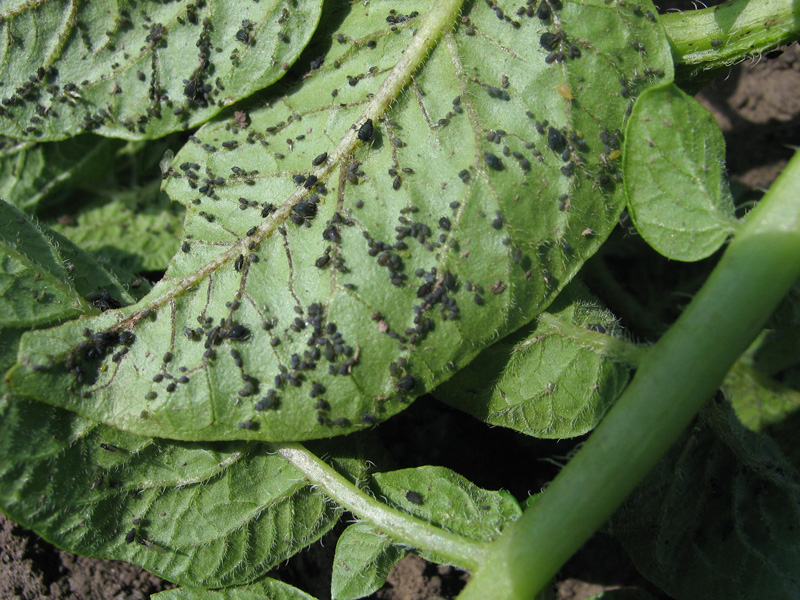
Colony of A. fabae nymphs on plants
(photo by M. Hurej)
Pest characteristics and description
Pest characteristics and description
This aphid is found in Poland on beet and legume plantations. It is one of the most important aphids in agricultural environments among non-potato aphids. It overwinters as eggs on viburnum, spindle, and jasmine. The species is often caught in large numbers in yellow traps in spring. It is polyphagous, feeding on many plant species as secondary hosts. In Europe, its occurrence increases eastward and it has a holocyclic (complete) development, while in other regions it can be anholocyclic (incomplete). In some parts of Europe, it is an important vector of the potato virus Y (PVY).
Bionomics
- Eggs – relatively large, about 0.5 mm long, gray or blackish-green, laid on the winter host.
- Larvae (harmful stage) – length 2.2 mm, oval body, very delicate, wingless nymphs – matte black (phot. 1) with a greenish tint – have two rows of transverse wax bands. The juvenile nymph resembles the adult. Piercing-sucking mouthparts feed on plant sap. Reproduction is parthenogenetic through multiple generations on potato (secondary host).
- Adult (harmful stage) – winged aphid, shiny, dark green or dark brown (phot. 2). Summer generation (migrants) is an active vector of viruses (PVY, PVM, PVS) transmitted to potato plants.
Life cycle
The black bean aphid is a heteroecious species with a holocyclic (complete) development. In the field, it has many secondary hosts (including potato, weeds, legumes). Eggs overwinter on spindle, viburnum, and jasmine. In early spring, larvae of the first generation of wingless parthenogenetic females hatch. Three to five generations develop on the winter host. In the third generation, winged females appear and migrate to summer hosts – herbaceous plants, weeds, beans, beet, poppy, and potatoes. After mating, females lay eggs in autumn on weeds. Winged migrants produce fewer offspring – 25 larvae in groups of 3-7. Up to 7 generations (sometimes 10) can develop on beet. During dry and warm weather, colonies rapidly establish in new locations (potatoes) with migrants dispersing over long distances (wind-aided). In July, migrants move from beet to Chenopodium weeds and produce 4-5 generations. Finally, winged autumn forms migrate to the winter host – spindle – where wingless females lay eggs after mating.
Occurrence and harmfulness
The species occurs abundantly in Poland, mainly in warm years and where the winter host and secondary hosts – beet, beans, weeds – are present.
Aphids reach potato in a second wave of dispersal flights, usually producing two generations there. A. fabae is a major virus vector, causing degradation of seed material and cultivated varieties. It transmits PVM and PVY – currently the most economically important virus in potatoes grown in Poland. Its abundance varies yearly, being higher in dry, warm springs and lower in cold, wet seasons. Aphids feed on the undersides of leaves, sucking sap and twisting tissue. Vegetative propagation of potato through tubers increases virus incidence year by year, reducing yields. Therefore, seed material should be frequently replaced depending on varietal susceptibility. Adults and nymph colonies also directly damage potato green parts, though leaf curling and deformation are rare.
Economic threshold
Not established for potato.
Monitoring requires frequent field observations after planting and during summer growth. Aphids can be mechanically collected using a Johnson aspirator. Monitoring can be done with yellow traps (winged aphids) or by counting aphids on the lower surface of leaves in the middle plant layer (100-leaf method).
Due to early appearance, this aphid may pose a significant threat to young potato plants.
Control methods
The primary protection method is seed tuber treatment with systemic insecticide at planting. Currently, only one seed treatment is available – Prestige Forte 370 FS, containing a systemic active ingredient. The most common control is foliar insecticide application. The first spray should be applied when the first aphids are detected on leaves or in yellow traps. Subsequent sprays are applied every 7-14 days, depending on actual infestation. Spraying with mineral oils does not effectively kill aphids but may reduce their numbers and limit virus transmission, playing an important role in seed potato protection.
It is also very important to avoid weed infestation, as viruses can reside in weeds. Some weeds (e.g., Chenopodium album) are hosts for certain aphids, including Aphis fabae. Excessive nitrogen fertilization (>150 kg/ha) promotes lush growth, favoring aphid development. Essential oils from certain plants can act as repellents or insecticides. Studies report effectiveness for rosemary, lavender, thyme, and peppermint oils, although application remains technically challenging.
Other methods to reduce aphid flights to the crop include covering ridges with chopped cereal straw or planting trap crops in strips around the field (soy, sorghum, wheat, oats). Both methods reduce vector numbers and virus transmission to tubers (PVY).
Eliminating winter hosts – spindle, viburnum, and jasmine – and avoiding seed potato plots near these plants significantly reduces A. fabae populations.
Compiled by: Dr. Tomasz Erlichowski